VCE Education
VCE Education is an educational website offering VCE tutoring services with diverse courses including VCE English Language Program, VCE Chemistry Program, VCE Maths Methods Program, and Year 7-10 English. VCE Education is committed to helping students achieve excellent academic results and foster academic growth through its professional teaching team, quality courses, and comprehensive support.
+ 48
Average Ranking
+ 301%
Website Exposure
+ 141%
Website Clicks
+ 147
Google 1st Page Keywords
Data from August 2024 to January 2025
The Problem
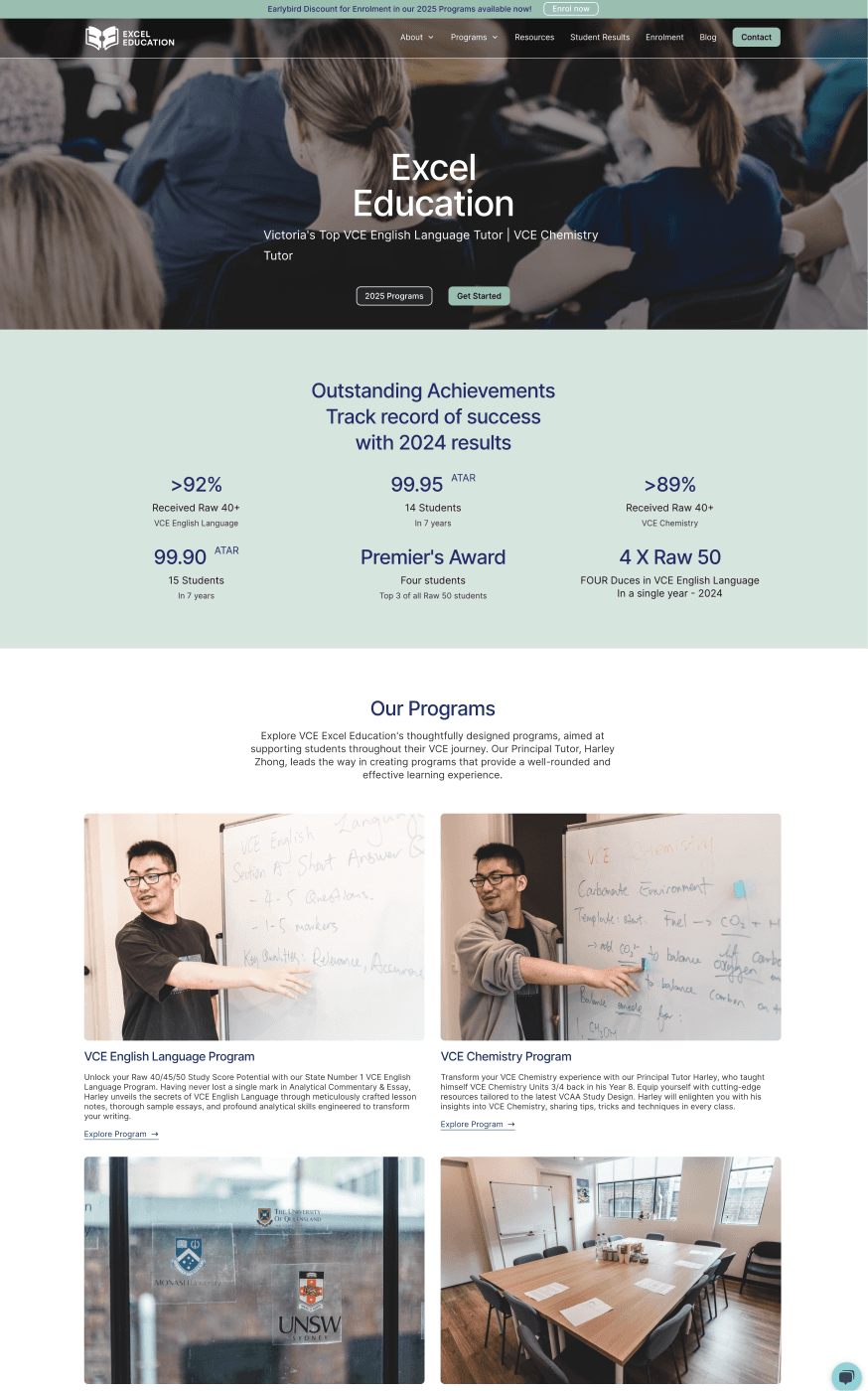
VCE Education has an established teaching team and high-quality course content, but none of that was reflected in search results.
VCE tutoring is a highly homogenised market: large numbers of tutoring providers and course platforms compete for the same set of keywords, and those keywords carry exceptional commercial value — behind every search for "vce chemistry tutor" is a family ready to pay. The result is that the ranking threshold on core terms has been pushed very high, VCE Education’s website sat stuck against a traffic ceiling, and its rankings never reached the leading positions in search results.
The sector has another distinctive feature: demand is highly concentrated and comes with clear time windows. Students and parents search intensively for tutoring in specific periods — at the start of term and ahead of exam season — and once those windows pass, even a subsequent improvement in ranking arrives too late for that intake. That makes the urgency of ranking improvement far greater than in most industries.
The client’s brief was a systematic programme capable of breaking the deadlock: raising search visibility quickly, focusing traffic precisely on VCE students and parents in Australia — and particularly in Victoria — and converting those visits into actual course enquiries and enrolments.

Our Solution
Our judgement was that the core terms in the VCE tutoring market were already fully occupied by incumbents, and contesting them directly in the short term would cost too much. The real opportunity lay in subject-level segmentation — every VCE subject and every stage of exam preparation corresponds to a set of specific queries with far lower competition. The strategy was therefore set: expand coverage rapidly through subject-specific content, while locking onto the people who actually enrol using Victorian local terms.
Restructuring Site Architecture and Page Performance
Education sites carry large volumes of course information, subject descriptions, staff profiles and student case studies, and a disorganised structure prevents search engines from determining page topics and stops authority passing through effectively. We redesigned the site’s information architecture, organising course pages by subject and year level so every page has clear topical boundaries, and replanned navigation and internal linking to channel authority toward the course pages with the greatest commercial value.
On performance, we stripped redundant code and compressed asset sizes, improving load speed markedly. This matters particularly for education sites — parents comparing providers typically open several sites in succession, and the slow one is often closed before its content is ever seen.
Subject Content Built Around Exam Preparation
We anchored content on the real problems students encounter throughout VCE preparation, rather than promoting the institution in general terms. Around each subject’s study techniques, study design changes and learning methods, we systematically built a blog and study resource library — specific, actionable pieces such as "What is GAT? How I got a study score of 50 in the writing section?" and "An Overview of 2024 Chemistry Study Design".
On keywords, we targeted queries closely tied to tutoring demand — "vce english language exam", "vce chemistry tutor". This content works on two levels: for students and parents it solves a real problem first, establishing professional trust; for search engines, a coherent body of subject content builds authority across the whole VCE tutoring topic, which no individual course page could achieve alone.
Victorian Local Keyword Coverage
VCE Education serves all of Australia, but the bulk of actual enrolments concentrate in Victoria — VCE is Victoria’s examination system to begin with. We therefore treated local terms as a separate optimisation layer, focusing on Subject × Location combinations such as "vce english language tutor melbourne" and "vce chemistry tutor melbourne".
Search volumes for these terms are lower than for broad keywords, but intent and geography are both unambiguous, making this the highest-converting traffic available. With limited budget and content capacity, securing these terms delivers far better returns than contesting broad terms.
Simplifying the Enquiry Path and Mobile Experience
The conversion endpoint for education services is an enquiry or enrolment; however much traffic arrives, an obstructed path means it cannot be monetised. We simplified the registration and enquiry flows, cutting non-essential fields so students and parents could raise an enquiry immediately after reviewing a course rather than being deterred by a long form.
We also completed a full responsive optimisation for mobile. A meaningful share of this audience is students searching on their own phones with parents following up on theirs, and mobile load speed and form experience directly determine how efficiently that traffic converts.
Education Sector Links and Genuine Word of Mouth
In a category as competitive as education, domain authority is a hard ranking threshold. We established partnerships with education forums, industry blogs, schools and education associations to secure high-quality backlinks within relevant content, continuously lifting the site’s authority and credibility. We prioritised sources within the education sector — topical relevance contributes far more to subject authority than general-purpose backlinks.
We also encouraged students and parents to share genuine accounts of their learning experience and score improvements on the site. That content is both the evidence new visitors weigh most heavily and a continuous source of naturally updated original material for the site.
Data-Driven Continuous Optimisation
SEO results come from sustained iteration rather than one-off action. Throughout the project we reviewed user behaviour data regularly through Google Analytics and similar tools — which pages drew the most visits, where bounce rates ran abnormally high, and at which step users abandoned the enquiry flow. Each round of analysis fed directly into the next round of adjustments to page structure, content and conversion paths, closing the optimisation loop.
The Result
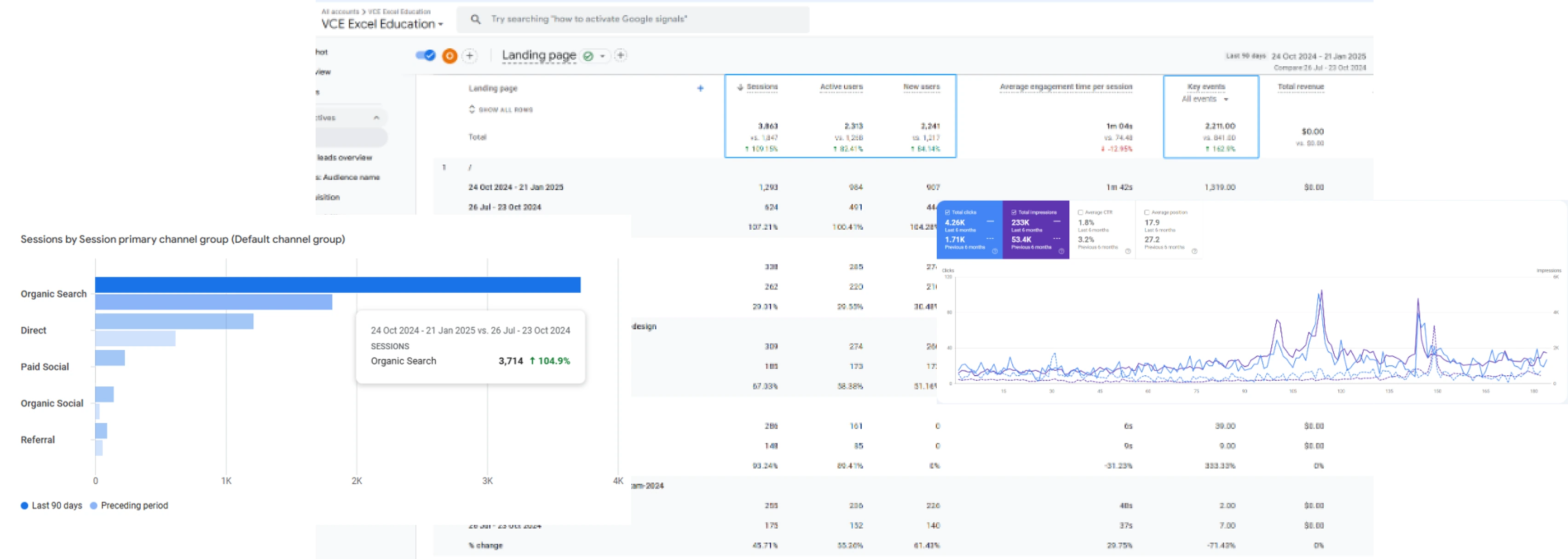
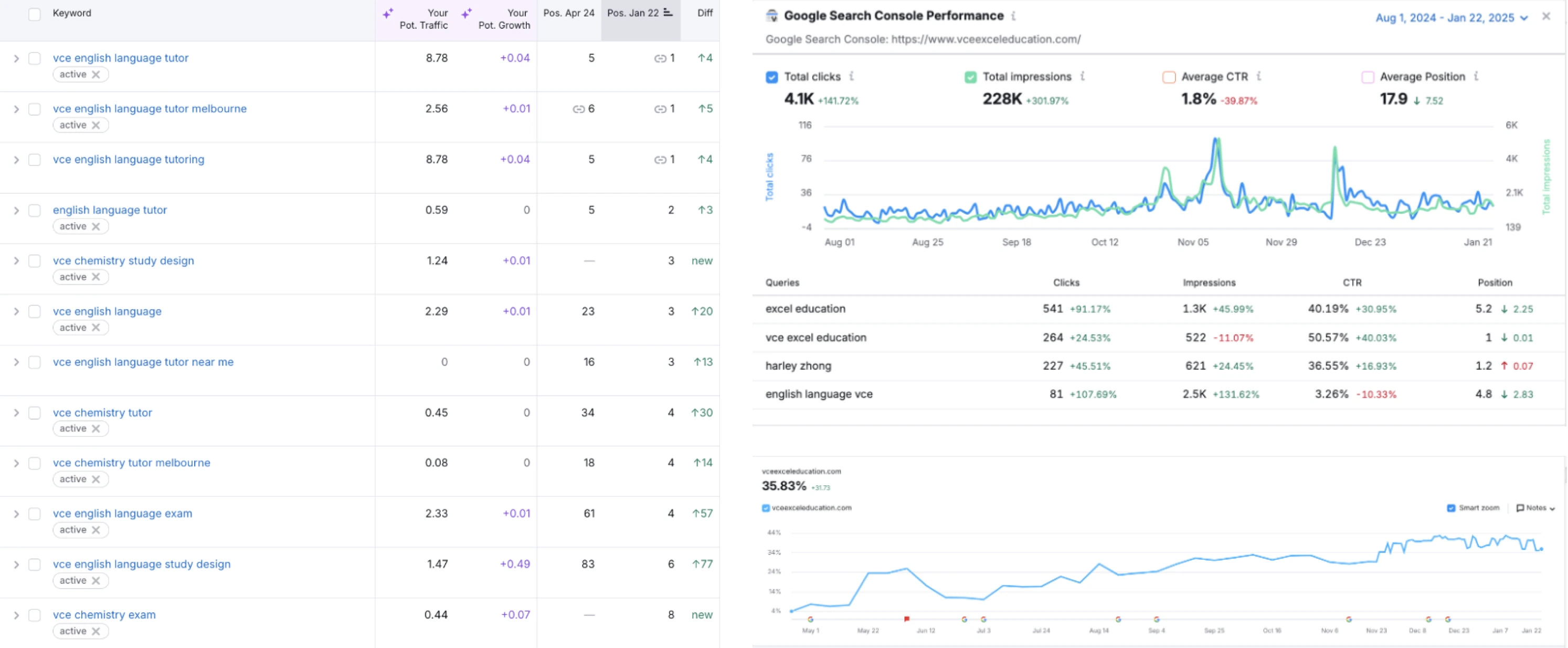
From August 2024 to January 2025: website impressions rose 301%, website clicks rose 141%, average keyword ranking improved by 48 positions, and 147 keywords reached Google’s first page. Over the same period organic traffic grew 104.9% quarter on quarter, and the conversion rate from online enquiries and course enrolments improved 162.9%.
The 147 keywords reaching the first page is the heaviest figure in this set. Clicks in search behaviour concentrate almost entirely on the first page, and whether a term sits at position 11 or position 9 makes an order-of-magnitude difference to the traffic it produces. Combined with the 48-position improvement in average ranking, this shows the subject segmentation strategy worked on both breadth and position — pushing large numbers of previously invisible queries into the range that actually performs.
Impressions grew 301% against clicks at 141%, and that gap needs stating honestly: a considerable share of the new impressions came from keywords that had only just climbed to the second and third pages, generating impressions but not yet occupying high-click positions. This is the typical shape of a mid-stage SEO programme, and it means there is a further wave of unreleased click growth as those terms continue to climb.
What genuinely validates traffic quality is the data at the end of the funnel. Organic traffic grew 104.9% quarter on quarter while enquiry and enrolment conversion rate improved 162.9% — conversion rate growing faster than traffic, meaning the intent strength of the additional visitors rose rather than fell. That directly confirms the effect of the Victorian local keywords: someone searching "vce chemistry tutor melbourne" is at a completely different decision stage from someone searching for tutoring in general.
For VCE Education, the outcome is not simply better ranking figures. In a market with highly concentrated demand and clearly defined time windows, the business now has an organic search channel capable of delivering students reliably in every enrolment season.
Related Projects
Check out other similar projects




Get a Free Quote
Let's talk about your goals
Melbourne
Scan the QR code to add our WeChat customer service for faster professional consultation.