Auslaw Review
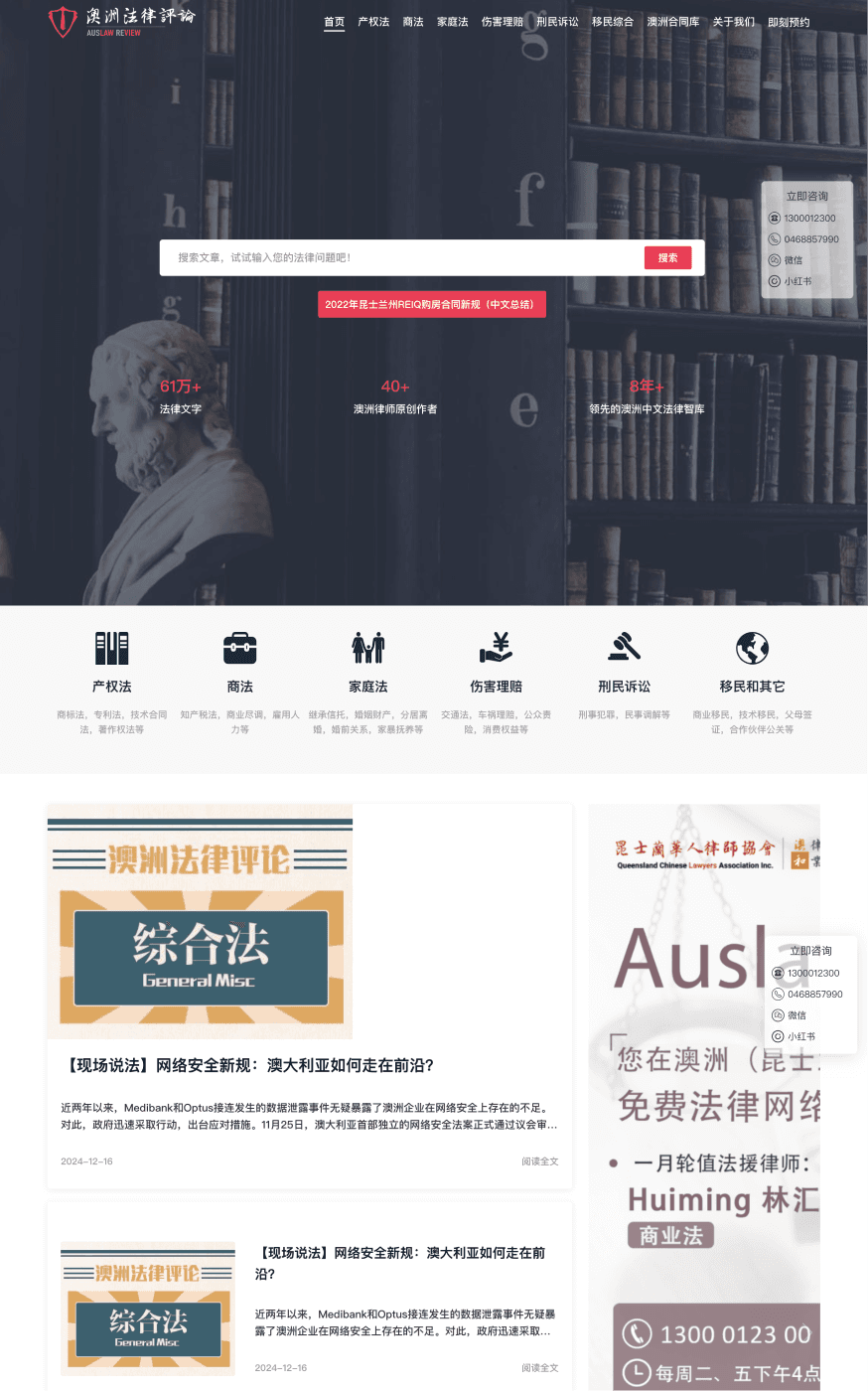
Established in 2016, Auslaw Review is a cross-regional legal service cooperation platform focused on providing Australian legal information. Over the years, it has achieved remarkable success, maintaining strong content production with over 2 articles daily and more than 50 monthly updates. Through professional and timely legal information, it has attracted nearly 5,000 followers, becoming a crucial resource for Chinese Australians seeking legal services, consultations, and pro bono legal aid. Auslawreview is committed to breaking down legal knowledge barriers, enabling every Chinese Australian to easily understand and apply Australian law, providing a solid legal shield for their life, work, and entrepreneurial journey abroad, helping them pursue their dreams without legal concerns.
+ 3
Average Ranking
+ 182%
Website Exposure
+ 169%
Website Clicks
+ 46
Google 1st Page Keywords
Data from December 2023 to January 2025
The Problem
Auslaw Review is a cross-regional legal services platform that has published Chinese-language legal information for the Australian Chinese community since 2016, producing more than two articles a day and over fifty a month. That output capacity is rare among comparable platforms — yet the investment had long failed to translate into search visibility.
Law is one of the most fiercely contested categories in organic search, and legal services aimed at Chinese-speaking clients even more so: the market is crowded with firm websites, legal information platforms and migration agencies, all steadily increasing their marketing investment. Auslaw Review’s content quality was not the weak point — ranking was. Target keywords consistently failed to reach meaningful positions, and a large volume of high-quality articles went unread simply because nobody could find them. For a platform whose core asset is content, that is the most expensive kind of waste: the cost has already been paid, but the value is never realised.
Restricted traffic fed directly into weak conversion. The site had accumulated a substantial library of valuable legal content, yet the number of readers who actually progressed to an enquiry was far below expectation — partly because too few people arrived, and partly because there was no effective bridge between the content and the enquiry channel. Readers finished an article and left.
The client’s brief had three layers: make the content genuinely visible in search results, convert reading traffic into real enquiries, and build brand recognition within the Australian Chinese community in the process.

Our Solution
Core legal keywords carry prohibitive competition costs, and a frontal assault had no realistic chance of success. Our judgement was that Auslaw Review’s genuine advantages lay in content depth and a precisely defined Chinese-speaking audience. The strategy therefore centred on long-tail question terms and localised combinations — accumulating authority through a large volume of specific, low-competition, high-intent queries, then working progressively toward the core terms.
Long-Tail Legal Keyword Research and Competitor Analysis
People with a legal problem rarely search for "lawyer". They search their actual situation: "what to do if my visa is refused", "how is property divided in a divorce", "workplace injury compensation entitlements". These long-tail question terms are fragmented and low in competition, but their intent is unmistakable — the person searching is in genuine difficulty, and their willingness to convert far exceeds that of broad-term traffic.
We systematically mapped the question vocabulary across the main practice areas — migration, family law, workplace injury, commercial contracts and property transactions — and dissected each competitor’s keyword footprint: which high-ranking terms they already held, how strong the competition was, and which valuable queries remained entirely uncovered. That analysis set the priorities, directing limited content capacity to wherever it would produce results fastest.
Localised Coverage for the Chinese Community
Legal services are tightly bound to jurisdiction: family law procedure in Queensland differs from Victoria, and almost everyone searching for a lawyer includes a place name. We treated geography as a separate optimisation layer, building a Region × Practice Area keyword matrix around the main service areas — Brisbane, Queensland, the Gold Coast — with terms such as "Brisbane law firm" and "Gold Coast migration lawyer".
We also accounted for search habits specific to Chinese-speaking users: mixing English and Chinese, and using colloquial terms current within the community. These are routinely missed by standard keyword tools, yet they are how this audience actually searches — and covering them properly delivers highly qualified traffic at very low competition cost.
Building Authority Through Q&A and Guide Content
Google applies especially strict content quality standards to YMYL categories such as law, and ranking depends substantially on whether a site can be judged a trustworthy source. We worked with the client to systematically build legal Q&A, procedural guides and FAQ pages around both everyday legal problems and time-sensitive developments.
The value of this content is twofold: for users, it genuinely solves a problem and establishes an initial sense that this firm knows its subject; for search engines, a coherent body of in-depth content creates topical coverage, accumulating authority across the legal field rather than on isolated keywords. That is the foundation that allows a long-tail strategy to work its way toward competitive core terms.
Restructuring the Site and the Conversion Path
Content generates traffic, but traffic that reads and leaves has no commercial value. We redesigned the navigation to organise legal services around the user’s actual decision path rather than internal business categories, so visitors could quickly locate the service matching their situation.
More importantly, we built a bridge between content and enquiry: embedding online enquiry entry points, client case studies and interactive Q&A modules within the guide and question pages, so a reader can act at the very moment their question is answered — instead of finishing an article and having to hunt for contact details. Page layouts were then refined continuously against behavioural data such as click-through rate and time on page, reducing conversion friction to a minimum.
Technical SEO and Page Performance
Legal information sites carry large volumes of content across deep page hierarchies, and a weak technical foundation directly caps indexing and ranking. We standardised meta tags, internal linking and URL rules, ensuring every page carried a clear topical signal and that authority flowed effectively through the site.
On performance, image optimisation and script reduction substantially cut load times, and we completed a full responsive rebuild for mobile — legal enquiries carry strong urgency, and users typically search on a phone at the moment the problem arises, making the mobile experience decisive for whether that traffic is retained.
Authoritative Link Building
Domain authority is a hard threshold for ranking on legal keywords. We established partnerships with Australian legal platforms, industry forums and relevant social media to secure a continuous stream of high-quality links from authoritative sources within the legal sector. We prioritised the topical relevance of each source over raw volume — a link from within the legal field contributes far more to topical authority than a general-purpose backlink.
The Result
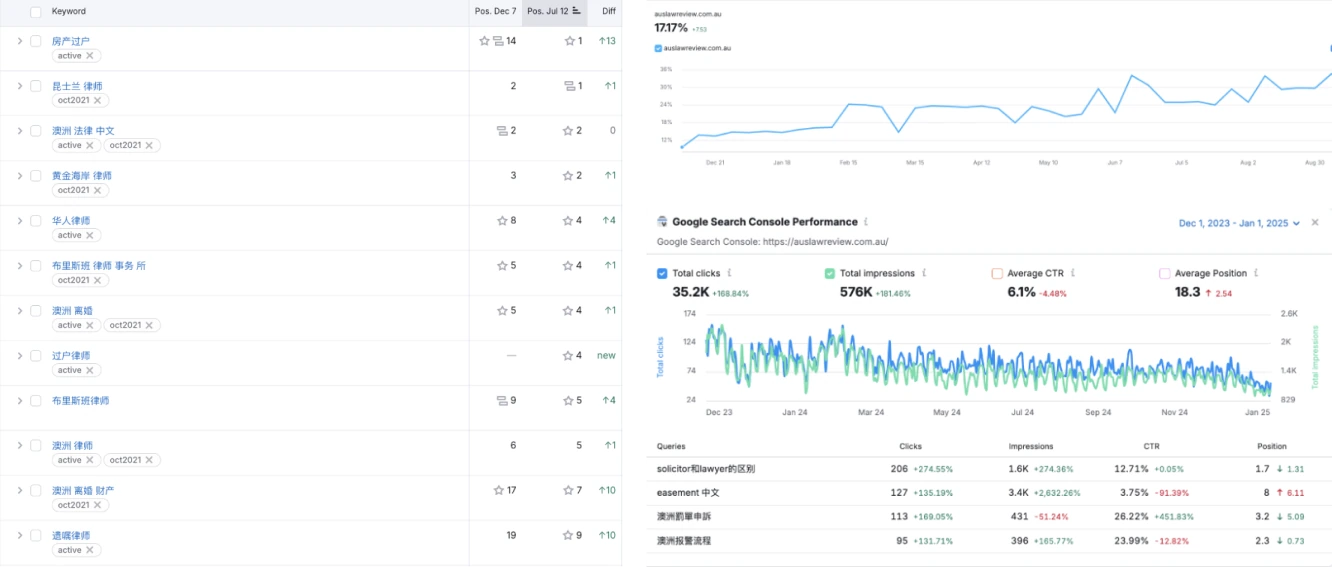
Over the fourteen months from December 2023 to January 2025: website impressions rose 182%, website clicks rose 169%, average ranking improved by 3 positions, and 46 keywords reached Google’s first page.
This describes a healthy organic growth structure. The 46 keywords now on Google’s first page show expanding breadth — the long-tail question strategy steadily bringing new queries into range; the 3-position improvement in average ranking shows existing terms also moving up. In search results, the click gain from each position is non-linear, particularly within the first page, and that 3-position shift is the direct source of the 182% growth in impressions.
More telling is the relationship between impressions and clicks. Impressions grew 182% and clicks 169% — almost in step, meaning that with impressions nearly tripling, click-through rate was essentially undiluted. When new impressions come from broad or poorly matched queries, click-through rate typically falls noticeably; clicks rising alongside impressions indicates the newly covered keywords aligned closely with genuine user intent, delivering real traffic rather than inflated impression counts.
For Auslaw Review, the significance of this route is that it sidestepped a head-on contest. Core legal keywords carry prohibitive competition costs, whereas long-tail question terms and localised combinations allowed the site to accumulate topical authority far more cheaply and then work progressively toward the contested core. Combined with the rebuilt bridge between content and enquiry, readers drawn in by the content could act at the moment their question was answered — turning reading traffic into genuine enquiry leads, and building the brand’s standing in Australian Chinese-language legal services along the way.
Related Projects
Check out other similar projects




Get a Free Quote
Let's talk about your goals
Melbourne
Scan the QR code to add our WeChat customer service for faster professional consultation.