Drag

Elephone

Elephone is a professional mobile phone and laptop repair company with seven stores across Melbourne. They specialize in a wide range of mobile device repair services, including screen replacements, battery repairs, and PC maintenance. Elephone also sells second-hand iPhones and mobile accessories, making it one of Australia’s leading suppliers of mobile and tablet accessories. Dedicated to reducing electronic waste, Elephone focuses on repairing electronic devices to improve the environment, aiming to maximize the benefits of technology while enjoying its advancements.

  • Category SEO
  • Industry Retail

Data from June 2022 to September 2022

The Problem

Phone repair is the textbook "nearby and now" need. Someone with a shattered screen or a battery that will not last the morning does not spend a week comparing prices — they pull out their phone, search "phone repair near me", and go to whichever shop ranks highest and sits closest. In this business, the outcome is decided almost entirely by the top few positions in local search.

Elephone operates seven stores across Melbourne. That network density should have been its single greatest competitive advantage, but those stores ranked poorly on Google Maps — customers simply did not see them when searching, leaving the advantage idle. The website’s organic visibility was equally weak, and specific services and prices — screen replacement, battery repair, PC repair — could not be surfaced at the search-results level. Customers had to click through to the site to find out what could be fixed and for how much, and every additional step lost another group of people who were already ready to buy.

The client’s brief was clear: convert the geographic advantage of seven stores into genuine local search visibility, so that anyone nearby looking for a repair finds the closest store immediately and knows, the moment they see the result, what can be fixed and what it costs.

Our Solution

We built a local SEO programme around Google Maps (Google Business Profile). The core judgement was this: for a seven-store repair chain, the most effective lever is not making the website bigger, but lifting each individual store’s local ranking within its own catchment — turning seven locations into seven independent traffic entry points.

Standardising and Localising Seven Store Listings

We rebuilt all seven Google My Business listings one by one, correcting addresses, phone numbers, opening hours and geographic coordinates, and linking each to the corresponding page on the website. The accuracy of this baseline data determines whether the algorithm is willing to surface a store in local results at all — a coordinate off by even one or two hundred metres can exclude a store from "near me" queries.

On that foundation we maintained a steady supply of genuine photography for each store: repairs in progress, before-and-after device comparisons, the shop interior, and the used handsets and accessories on sale. We also published regular Google Posts covering current offers and services. Both efforts solve the same problem — letting users judge from the results page alone that "this place can fix my device and looks trustworthy", without needing to visit the site.

Covering Local Intent by Service × Area

Repair searches are highly specific. Users do not search "phone repair"; they search "iPhone screen repair Box Hill", "laptop repair near me", "how much to replace a battery". We mapped high-frequency service terms — screen replacement, battery replacement, PC repair, used iPhones, phone accessories — against the suburb names of each store, and worked those combinations into the business categories, service listings, descriptions and matching website pages.

The effect is that each store gets matched precisely on the specific service queries within its own catchment, rather than seven stores competing against each other on the same broad terms.

Review Operations and Trust

In a service that involves handing an expensive device to a stranger, ratings and reviews are close to the only quality signal a customer has — and they are also a significant local ranking factor. We established a complete review programme for Elephone: prompting customers to leave genuine feedback after a repair, and following up on every review — thanking positive ones, and responding publicly to complaints with an explanation of how they were resolved.

With this running, Elephone’s stores held Google ratings between four and five stars and kept their review sections continuously updated. To the algorithm this reads as an active, credible business; to the customer it is the most direct basis for choosing a repair shop.



The Result

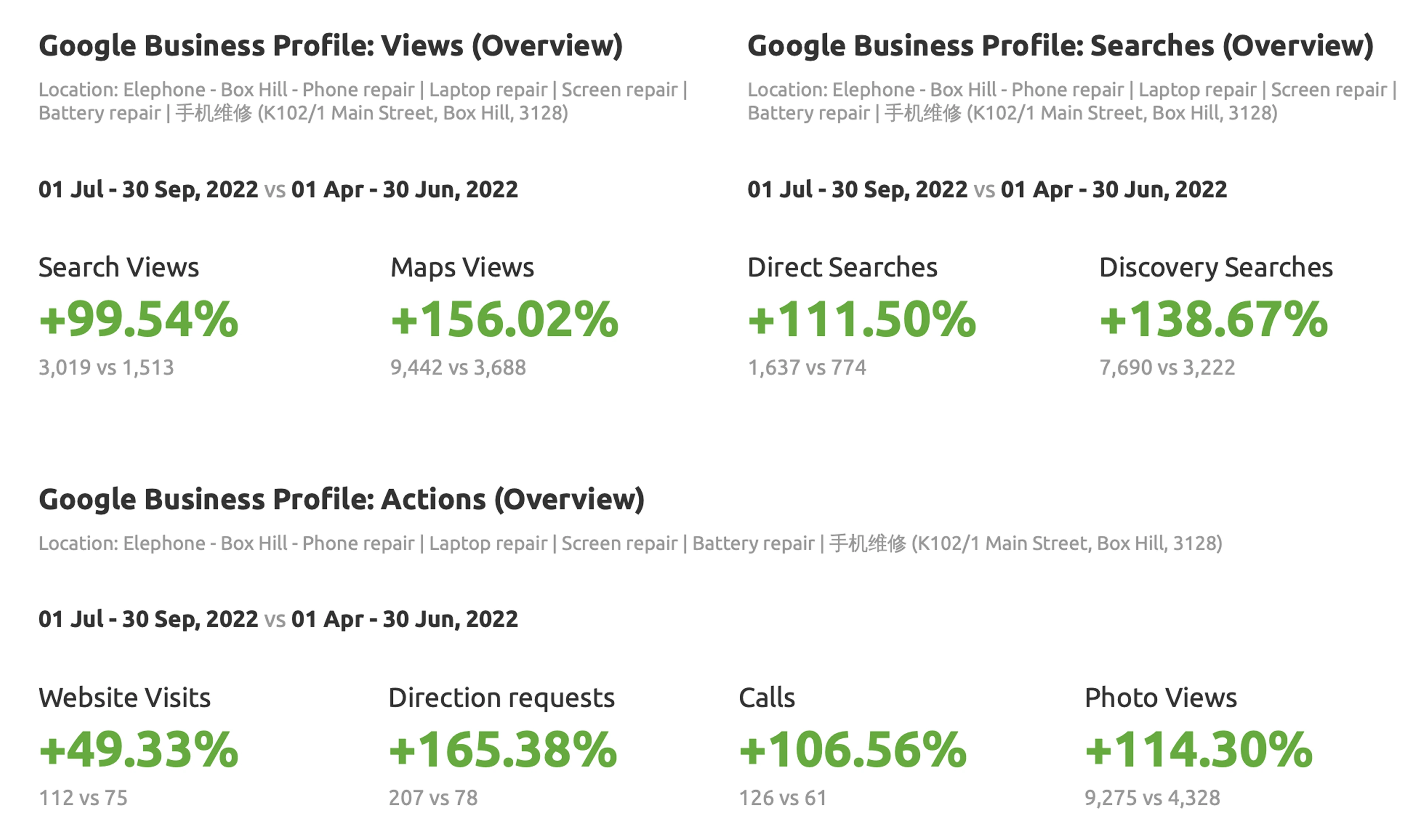
Taking the Box Hill store as an example, over the three months from June to September 2022: map views rose 156%, direction requests rose 165.4%, phone enquiries rose 106.6%, and website visits rose 49.3%. Breaking down the source of map searches, direct searches for the business name rose 111.5%, while searches for service keywords such as phone repair rose 138.67%.

Three signals in this data deserve separate comment.

First, direction requests grew fastest of all at 165.4%. In local services, requesting directions is the action closest to a completed sale — someone tapping for directions has already decided to go; all that remains is the journey. That this metric outpaced even view growth means what increased was not just exposure, but the number of people who actually walked through the door.

Second, service keyword searches (+138.67%) grew faster than direct brand-name searches (+111.5%). Brand-term growth comes from people who already know Elephone; service-term growth comes from people whose phone just broke and who have no idea where to take it. The latter growing faster means the new traffic was genuinely incremental — new customers rather than returning ones — which is the clearest evidence that the Service × Area keyword coverage was working.

Third, website visits grew noticeably less (49.3%) than every map-side metric. This is not a weakness; it is proof that the local conversion path was working as intended. Users made their decision on the map results page and called or navigated straight to the store, without needing to detour via the website. That eliminated step is exactly where customers used to be lost.

With local rankings lifted across all seven stores, Elephone finally converted its network density into genuine search coverage. Repair orders grew, the used iPhones and accessories displayed on the store listings generated additional purchase enquiries, and ratings held steady between four and five stars, continuously lowering the barrier for new customers.
Result Image

Related Projects

Check out other similar projects

GET A FREE QUOTE

Connect with us and let's make magic happen!

Melbourne

Scan the QR code to add our WeChat customer service for faster professional consultation.

WeBOOST WeChat customer service QR code, scan the code to add and learn about the local SEO solution in Melbourne, Australia