Pisell
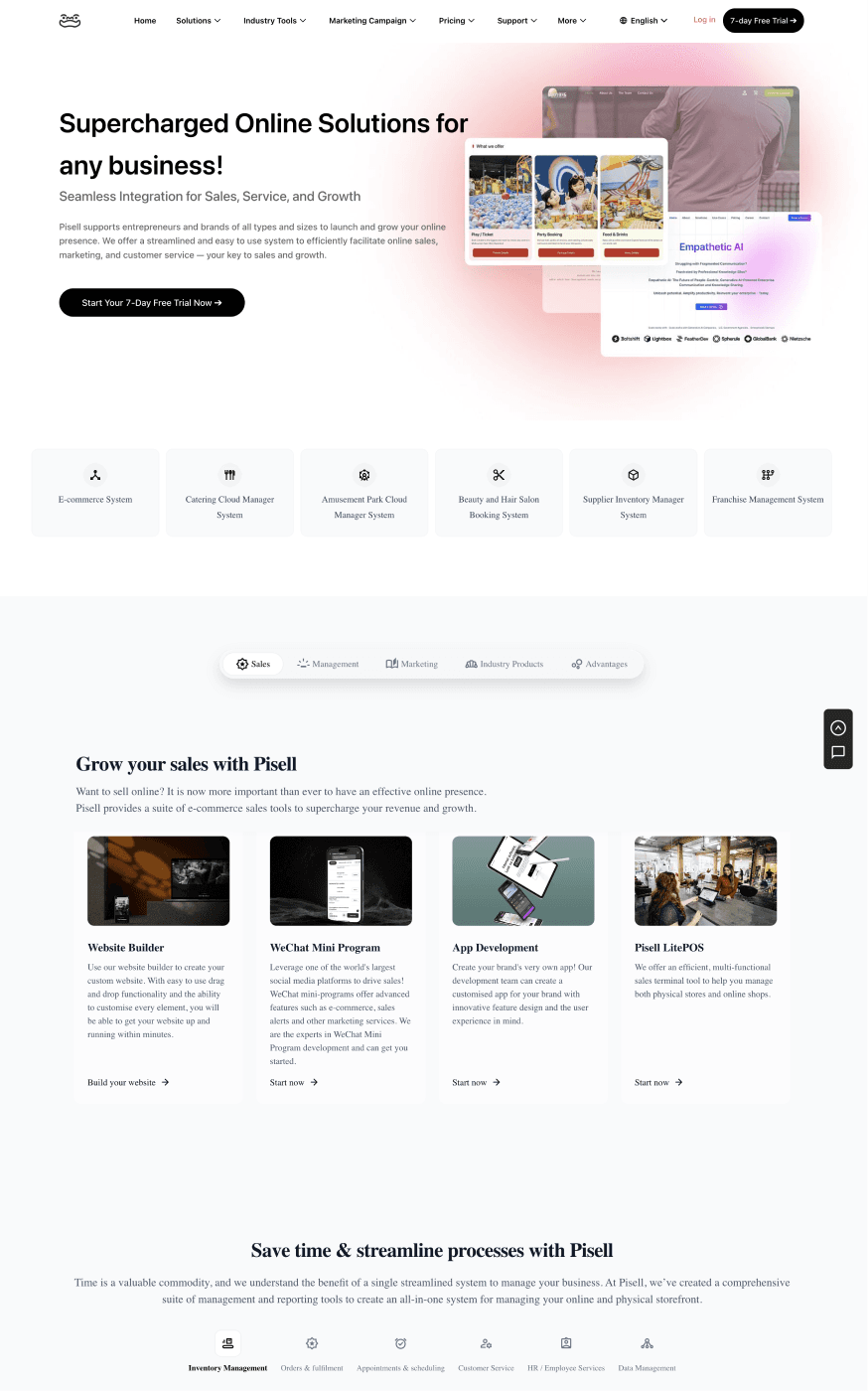
Founded in 2012, Pisell initially focused on serving the food and beverage industry. Over the years, it has continuously developed and refined its software products in response to market demands, undergoing more than ten system upgrades. Its service scope has expanded from the restaurant industry to include retail, beauty, education, entertainment, and more. Pisell is committed to becoming the most trusted leader in the internet services sector. By addressing sales, management, and marketing, the company aims to provide comprehensive digital transformation solutions for small and medium-sized enterprises (SMEs), enabling them to modernize and upgrade their operations effectively.
+36
Average Ranking
+ 52%
Website Impression
+ 36%
Website Traffic
+ 21
Google 1st Page Keywords
Data from February 2024 to May 2024
The Problem
Pisell’s product and service capabilities stand up well against its peers, but online growth had long been stuck against a ceiling.
The underlying cause was absence at the search layer. Business management systems are a textbook B2B purchase — when a restaurant or retail owner decides to replace a POS or membership system, the first step is almost invariably a search and comparison, not waiting for a salesperson to call. Competitors had established mature SEO strategies earlier and held the key positions on the results page; when users searched the same set of keywords, Pisell ranked below them, and a large volume of procurement demand that should have been theirs went elsewhere at the very first step.
The loss compounds. B2B system customers have long lifecycles, with renewals and upselling continuing over years, so a customer taken by a competitor represents not a single order but years of forgone revenue. System migration costs are also high — once a client has selected and deployed a platform, switching in the short term is close to impossible, which makes the competitive window in this category far more urgent than in consumer goods.
The client’s brief was to lift website traffic and search visibility quickly, so that businesses with genuine system procurement needs could find Pisell, and to close the gap in a market where competitors had already established an advantage.

Our Solution
Against competitors already holding a head start, contesting the broad industry terms head-on was too expensive and too slow. Our judgement was that B2B system procurement produces highly specific search behaviour, and the opportunity lay in more vertical, granular queries — territory competitors had not adequately covered, and where the searcher is precisely the decision-maker with the clearest intent.
Competitor Analysis and Gap Identification
We ran a systematic analysis of Pisell’s main competitors: their ranking distribution in search, which keywords they had secured, how their content strategy was organised, and the sources and quality of their backlinks.
The purpose was not imitation but establishing two things — exactly where the gap sat, and what parts of the landscape competitors had left uncovered. Only with that analysis could we direct limited resources at the positions most easily moved, rather than fighting on ground where competitors had already built defences.
Focusing on Highly Vertical Industry Keywords
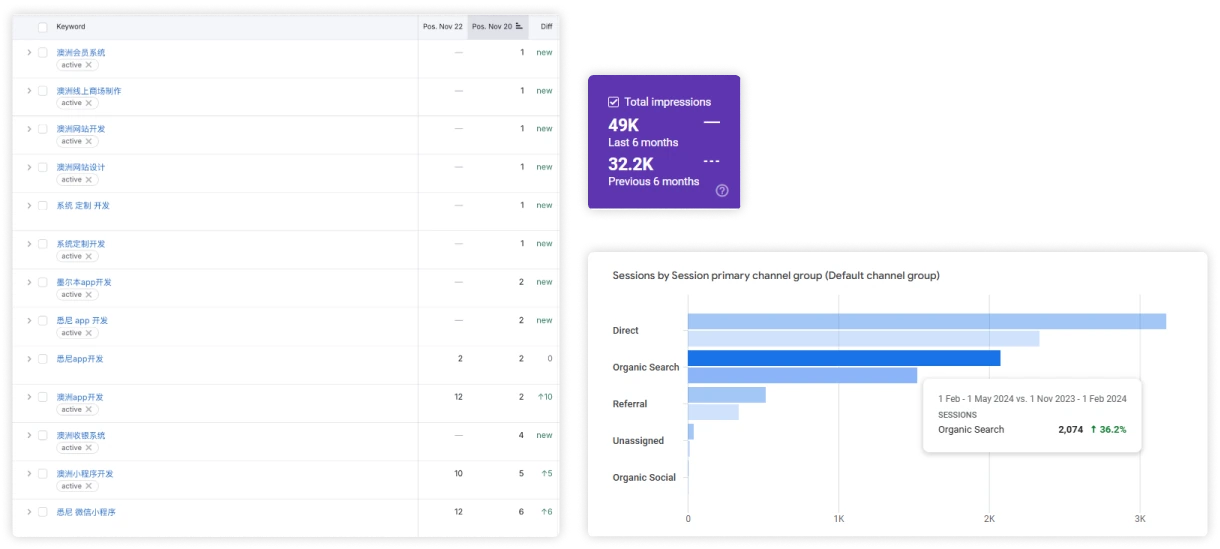
Using Ahrefs, SEMrush and other tools alongside Pisell’s business characteristics and market needs, we identified a set of industry keywords closely aligned with real user intent. The strategic weight was placed deliberately on highly vertical, granular terms — queries like "membership system Australia" and "POS system Australia" carry modest individual search volume, but almost everyone searching them is a merchant actively evaluating a purchase.
The conversion value of these terms far exceeds that of broad industry keywords, at a fraction of the competitive intensity. We cross-referenced competitors’ keyword positions and moved first into the granular areas they had not covered, building a differentiated advantage — opening our own entry points outside their strongholds.
Rebuilding URLs, Navigation and Load Performance
The original URLs were neither concise nor descriptive, making it difficult for search engines to determine page topics and impossible for users to anticipate where a link led. We restructured URLs to be clear and to incorporate target keywords, serving both machine interpretation and human understanding.
The navigation had been layered too deeply, leaving users lost and unable to locate the service information they wanted. We redesigned the structure, flattening levels and surfacing the main service entry points so visitors could reach their target directly.
On performance, we applied image compression, file consolidation, caching strategy and CDN acceleration to ensure every page loads within two seconds. B2B visitors typically compare several suppliers’ websites quickly during working hours, and slow loading means being eliminated from that comparison outright.
Content Rewriting and Case Studies
We carefully rewrote the key pages — features, industry products and marketing material — stripping redundant phrasing to make the information sharper, and integrating target and long-tail keywords to strengthen the match between page and search intent.
Beyond that, we produced specialist articles covering industry trends, technical explainers and case studies, extending the site’s content depth while demonstrating Pisell’s expertise to search engines and prospective clients alike.
Case studies are the most persuasive element in B2B conversion. We presented Pisell’s successful custom implementations in detail — what a procurement decision-maker most wants to know is not a feature list but "how is this working for a business like mine". Real cases answer that question directly and substantially reduce decision anxiety.
Technical SEO and Structured Data
We deployed SSL certificates across all pages, satisfying search engines’ preference for HTTPS while reassuring visitors as they browse — particularly important for a B2B site where users submit business information.
A full technical audit identified and resolved page errors, duplicate content and 404s, ensuring the site ran cleanly and met indexing standards. Mobile adaptation was completed in parallel, covering visitors browsing while out of the office or in transit.
We also added structured data markup to the main pages, helping search engines interpret page content accurately and allowing Pisell’s product and service pages to appear in richer formats in search results, lifting click-through rate.
The Result
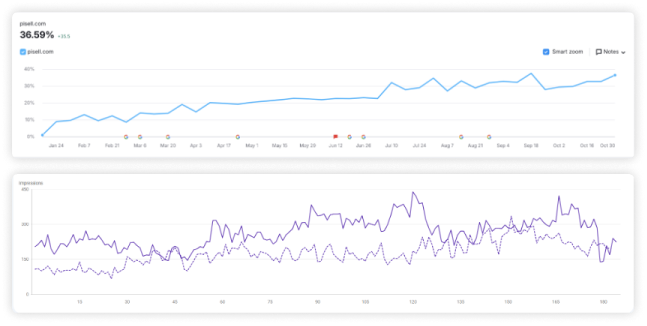
Over the three months from February to May 2024: website impressions rose 52%, website clicks rose 36%, average ranking improved by 36 positions, and 21 keywords reached Google’s first page. Over the same period impressions grew from 32.2K to approximately 49K, organic traffic rose 36.2% quarter on quarter, and conversion rate improved by close to 24%.
An average ranking gain of 36 positions within three months is the pivotal figure here. That magnitude means large batches of keywords moved from positions users would never scroll to into the range that actually generates impressions and clicks. Core keywords now hold the top three, with keyword rankings broadly on the first page — for a site previously suppressed deep in the results by competitors, that is a fundamental change of position.
Impressions growing 52% against clicks at 36% reflects the keywords that had only just climbed to the edge of the first page: they had begun generating impressions, but had not yet reached high-click positions. As those rankings consolidate, that pool of impressions converts progressively into actual visits.
The near-24% improvement in conversion rate shows traffic quality improved in step. This is the direct result of the vertical keyword strategy — someone searching "POS system Australia" is at a completely different procurement stage from someone searching a broad industry term. The former already knows what they want to buy and is simply choosing a supplier. Traffic growth and conversion improvement occurring together means the additional visits were not idle industry browsing but merchants genuinely evaluating a purchase, and online enquiries rose accordingly.
With competitors still holding the dominant market position, Pisell used differentiated keyword coverage to sidestep a war of attrition, establishing its own search entry points in the granular areas competitors had not reached and steadily narrowing the gap. For a B2B systems business with long customer lifecycles and high switching costs, every customer this channel delivers locks in years of continuing revenue.
Related Projects
Check out other similar projects




Get a Free Quote
Let's talk about your goals
Melbourne
Scan the QR code to add our WeChat customer service for faster professional consultation.