Recovering rankings after a redesign is not a matter of simply "optimising again". We began with a full diagnosis to establish precisely what had been lost in the rebuild, then worked through three layers in turn: technical foundations, content coverage, and monitoring.
Technical Audit and Structural Repair
We ran a complete technical review of the site, focusing on the problems the redesign had left behind: noticeably slow page loading, and an internal linking structure that prevented authority from reaching important pages.
We restructured the code and compressed image sizes to lift load speed significantly, and rebuilt the internal linking so core service pages could be crawled properly and receive sufficient authority from within the site. Mobile adaptation was optimised alongside — a great deal of study-abroad and migration research happens on phones, often in fragments of time between classes or on a commute, and the loading experience directly affects retention.
Rebuilding Keyword Coverage
We conducted systematic keyword research across the migration, study-abroad and visa sector, covering both fiercely contested core terms and high-volume specific queries. Keywords were then redistributed across the homepage and inner pages, ensuring each page had a clear topic closely matched to its target terms — rather than every term being piled onto the homepage where they dilute one another.
On content, we maintained a steady stream of high-quality material built around current industry developments and real client needs: detailed migration policy explainers, and application procedures and document checklists for each visa category. This is particularly important in this sector, where policy changes frequently — a site that interprets policy promptly and accurately gets revisited by users and recognised by search engines as a reliable source in the field.
Daily Monitoring and Agile Adjustment
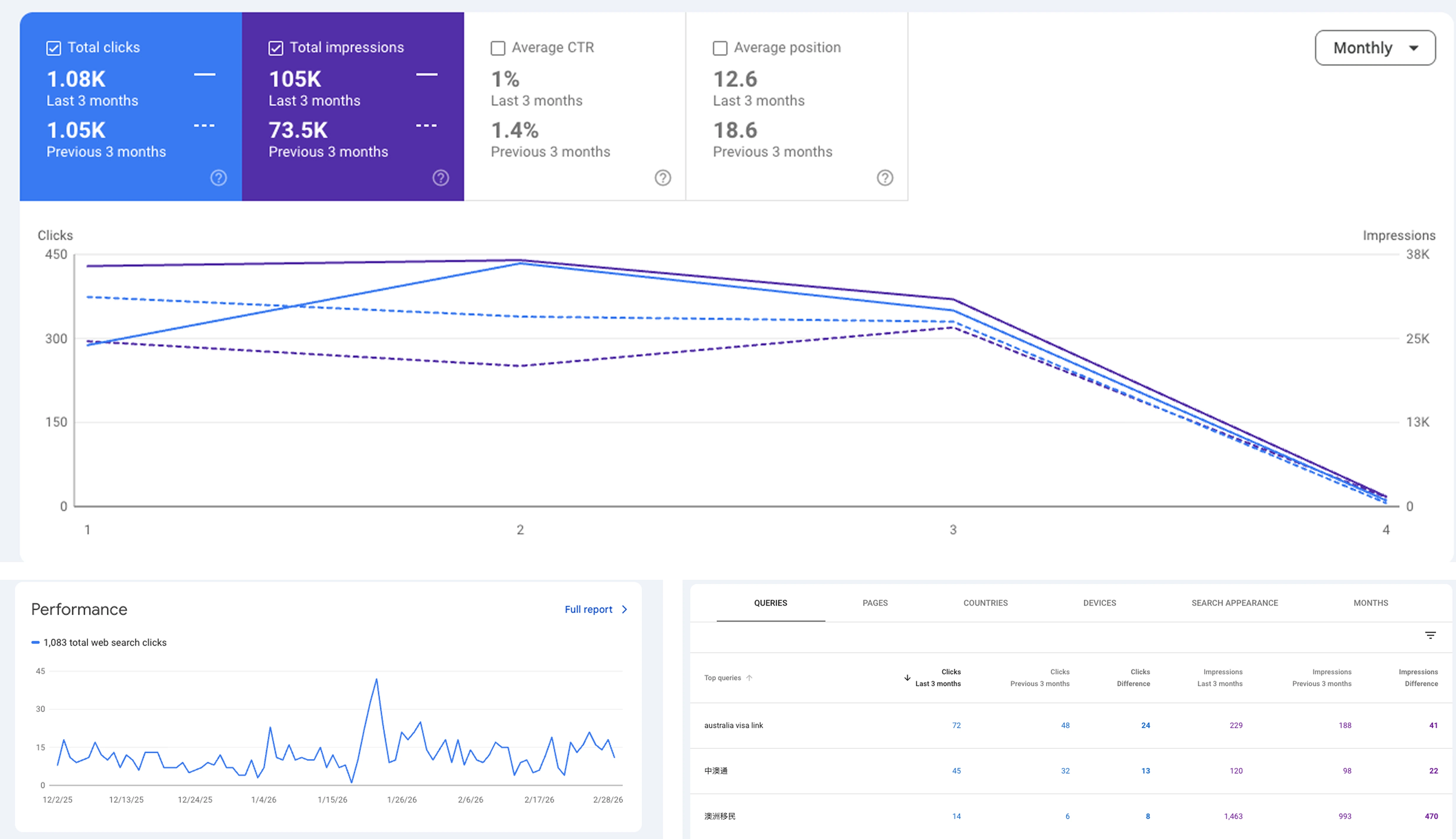
Volatility during a recovery period is far greater than in a steady state, and lagging monitoring means problems are only discovered after traffic has already been lost. We put daily-level ranking monitoring in place for AVL, so any abnormal movement in a target keyword could be diagnosed and addressed immediately.
We also tracked visit volume, page depth and time on site to understand user behaviour, and monitored enquiry form submissions — the only hard measure of whether SEO is genuinely producing client growth. Rankings and traffic may look impressive, but without enquiries there is no commercial value.
We analysed competitors’ SEO strategies on a regular cycle as well: which keywords they ranked well on, and how frequently and how well they were publishing. Based on that data we provided AVL with ongoing recommendations and adjusted strategy dynamically to hold a leading position in the sector.