Kylin Australia
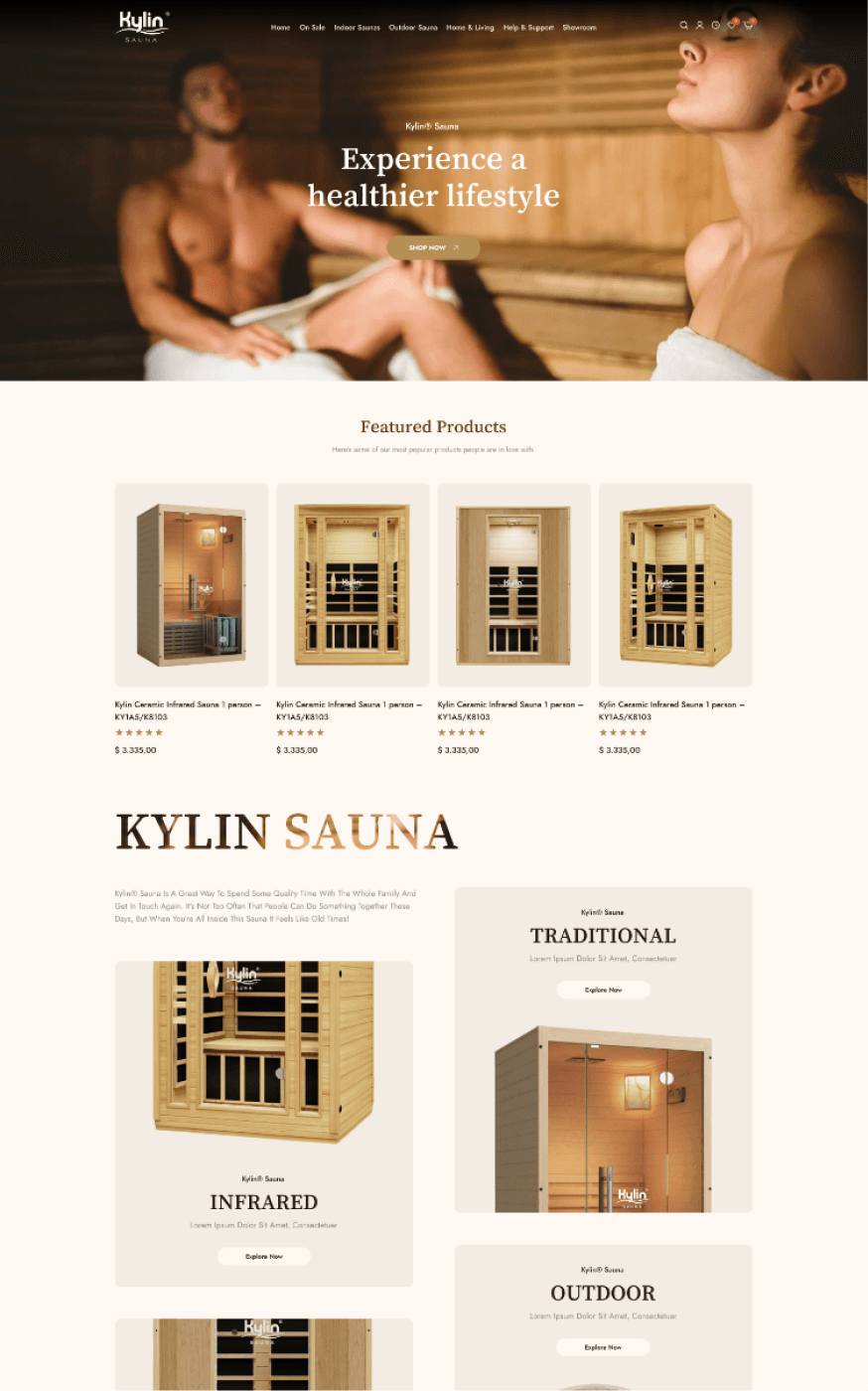
Kylin Australia specializes in providing high-quality Kylin far-infrared saunas to consumers. Through a factory-direct sales model, consumers can enjoy premium products at affordable prices without bearing upfront costs, significantly reducing their financial burden. Kylin is committed to continuously improving product quality, optimizing services, and further reducing costs, enabling more people to experience the health and comfort of far-infrared saunas, becoming a leader in the far-infrared sauna sales sector.
+ 23
Core Keyword Ranking
+ 3
Site-wide Avg. Ranking
+ 53%
Website Impressions
+ 33%
Website Clicks
Data from October 2024 to January 2025
The Problem
Infrared saunas moved rapidly from a niche category to the mainstream in Australia, bringing product homogenisation and an escalating price war with them. For Kylin Australia this created an awkward position: the brand sells factory-direct and therefore holds a genuine cost-structure advantage, but when every competitor is discounting, a price advantage is quickly eroded into a war of attrition nobody wins.
The real problem was visibility. Before committing several thousand dollars to a sauna, consumers almost invariably go through a full round of online research — comparing models, understanding the technical differences, reading genuine reviews. Competitors were steadily increasing their investment in SEO and online exposure, and Kylin was absent from the very start of that decision path: users were not putting it on their shortlist at all, so the price and quality advantages of buying factory-direct never had a chance to be seen.
High-value products of this kind also carry long decision cycles and dense information needs, making pure paid acquisition difficult to sustain. What the client needed was systematic work at the organic search level — a sustainable way to lift exposure, traffic and sales, and to rebuild a distinguishable position within a homogenised market rather than being dragged further into a price war.

Our Solution
In a homogenised market, the goal of SEO is not to rank for everything, but to make sure users see Kylin during the comparison stage — and can tell the difference once they do. The plan therefore ran along two lines: cover real search scenarios through fine-grained product segmentation, and make the differentiation stand up on the page through comparison-led content.
Rebuilding Site Architecture and Keywords by Product Dimension
Buying a sauna is a highly parameterised decision — users first settle how many people it needs to fit, whether it goes indoors or outdoors, and whether they want traditional or infrared, before they ever start comparing specific models. The original site structure did not reflect that logic, so users could not find the right products and search engines could not match granular queries to the right pages.
We restructured the site around capacity (one, two, multi-person), installation context (indoor, outdoor, portable) and heating technology (traditional, infrared), with a dedicated landing page for each combination. On that foundation we dissected competitors’ keyword positions, selected terms with meaningful volume and strong conversion potential, and worked them naturally into the corresponding pages. The result: someone searching "two person outdoor infrared sauna" lands on an exactly matching page rather than being dropped into a generic product list.
Comparison-Led Content to Surface Product Differences
This is the most effective response to a price war — pulling the contest back from price onto product. We ran competitor comparison analyses for the highest-demand products and set out Kylin’s points of difference explicitly on the page: premium materials, more than ten light therapy modes, high-quality Bluetooth audio, advanced infrared technology, and energy efficiency.
Presentation was the critical part: not a list of specifications, but a format that lets a prospective buyer see, within a single screen, what the extra money actually buys. Once the differences are clearly displayed, price stops being the only axis of comparison, and the value of buying factory-direct finally becomes something the customer can perceive.
Completing Product Page Information and the Purchase Path
For a several-thousand-dollar product, insufficient information is the single biggest barrier to conversion. We completed detailed specifications and high-quality product photography on every product page, encouraged genuine customer reviews to build credibility, and added a product comparison feature — letting users compare directly on site rather than juggling five browser tabs.
The purchase flow itself was streamlined, reducing the steps and friction between decision and order. For a high-value product, any unnecessary point of hesitation can send a customer back to comparing alternatives.
Content Marketing to Capture Research-Stage Traffic
A large share of prospective customers are not yet choosing a model — they are searching "what are the benefits of infrared saunas" and "how do I choose a sauna". We built usage guides and in-depth wellness content to capture that research-stage traffic.
This content covers substantial long-tail search while establishing professional credibility, and guides interest-stage readers progressively toward product pages, bridging awareness and purchase.
Technical Performance and Link Building
Technically we optimised images and code and stripped redundant data, cutting load times significantly, and completed full mobile adaptation — how large product images load and render on a phone directly affects the browsing experience for this category.
On links, we built partnerships with high-quality industry sites, using authoritative backlinks to steadily raise domain authority and credibility, laying the foundation for ranking on the more competitive core product terms.
Advance Positioning for Sales Events and Data Iteration
Sauna sales show a pronounced event effect. We put SEO and content in place well ahead of major sales periods such as Black Friday, targeting combinations like "Black Friday sauna deals" and "biggest discount of the year" — search volume for these terms spikes just before the event, but rankings take weeks to establish, and launching at the last minute is too late.
Throughout the project we tracked traffic, conversion rate and bounce rate through Google Search Console and Google Analytics, using behavioural data to determine which page layouts and content formats best drove conversion, and iterating accordingly.
The Result
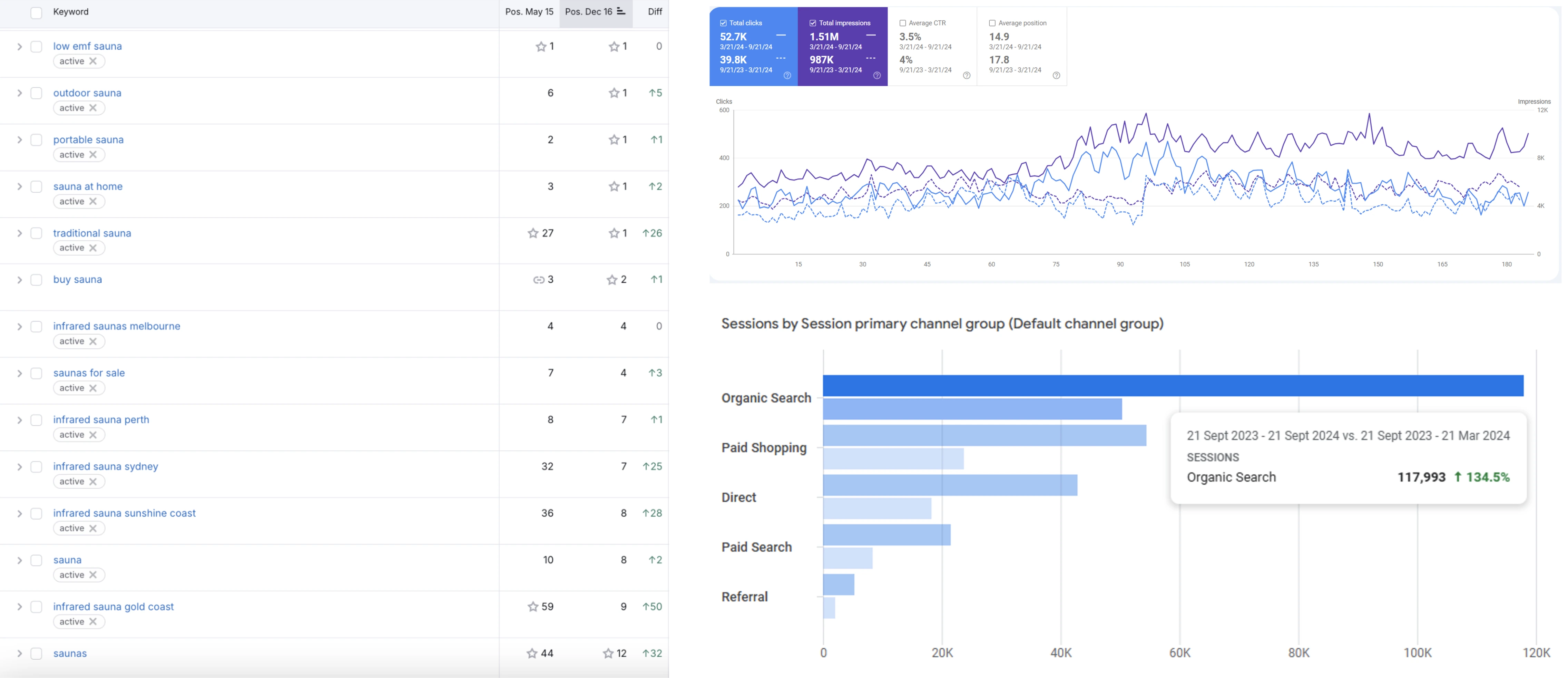
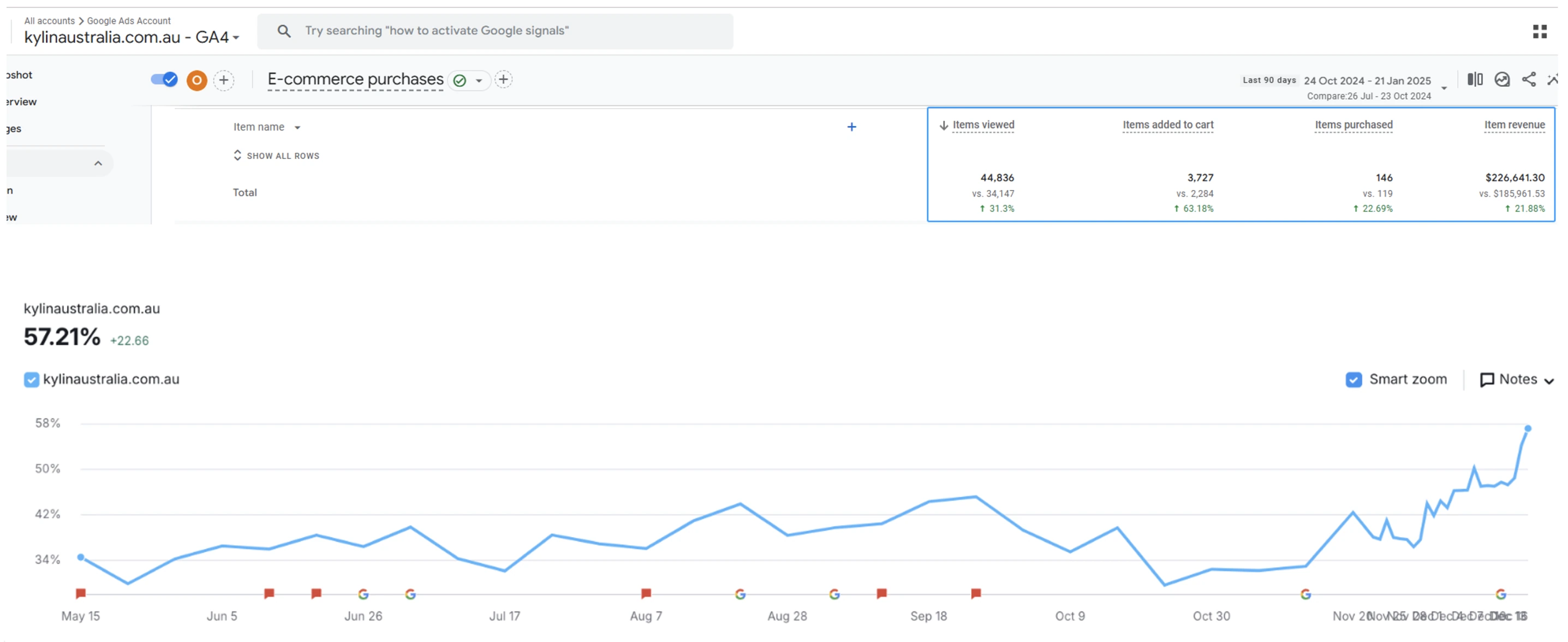
From October 2024 to January 2025: core keyword rankings improved by 23 positions, site-wide average keyword ranking improved by 3 positions, website impressions rose 53%, and website clicks rose 33%. Over the same period organic traffic grew 134.5%, while over the most recent 90 days sales volume grew 22.69% quarter on quarter and revenue grew 21.88%.
Core keywords up 23 positions against a site-wide average of just 3 — that gap is itself the strategy made visible. Had resources been spread evenly across all keywords, the two figures would have moved together. Core terms rising almost eight times faster than the site-wide average shows optimisation effort was deliberately concentrated on the commercially valuable product terms rather than chasing a flattering overall mean. For a high-value product this is the correct trade-off: a single core product term reaching the first page is worth more in sales than dozens of long-tail terms nudging up a place.
Impressions growing 53% against clicks at 33% reflects the long-tail terms carried along in the process — their rankings improved enough to start generating impressions, but not yet far enough forward to convert fully into clicks. Those impressions are the reserve behind subsequent growth.
The real weight sits on the commercial side. Sales volume grew 22.69% quarter on quarter and revenue grew 21.88% — two figures that are almost identical, and that near-equality matters more than the numbers themselves: it means average order value held steady, and growth was not bought with discounts.
For a category deep in a price war, this is the crucial point. Competitors were trading discounts for volume, which fundamentally means trading margin for scale; Kylin’s sales volume and revenue growing in lockstep means the additional orders closed at existing prices. Behind that is the comparison-led product content doing its work — once premium materials, ten-plus light therapy modes and infrared technology are clearly laid out, the consumer’s axis of comparison shifts from "which is cheaper" to "what does this price actually buy".
With core product terms holding on the first page, and product information and purchase paths rebuilt, Kylin re-established a distinguishable position in a homogenised market — through an organic search channel that, unlike paid advertising, does not require ever-increasing spend to maintain.
Related Projects
Check out other similar projects




Get a Free Quote
Let's talk about your goals
Melbourne
Scan the QR code to add our WeChat customer service for faster professional consultation.