Drag

Sexy Devil

Sexy Devil is an online adult products company based in Australia, focusing on providing high-quality, safe and healthy adult products for adults. Their products cover various categories, including adult products for men and women, sexy lingerie, sexy props, etc.

  • Category SEO
  • Industry Retail

Data from March 2022 to October 2022

The Problem

Promotion in the adult products industry is considerably harder than in ordinary e-commerce, for a specific reason: the category faces strict restrictions on mainstream advertising platforms, and most paid channels are simply closed to it. That means organic search is effectively the only scalable acquisition route available — and the positions along that route had long been held firmly by a small number of established brands.

For an emerging brand like Sexy Devil, the position was difficult. The main traffic entry points were occupied, competitive intensity was extreme, and low brand awareness meant it could neither capture brand-term searches nor build user trust quickly — and in adult products, whether a retailer is reliable and whether privacy is protected carry even more weight in the purchase decision than price.

The client’s focus had previously been offline sales channels, but it became clear that the centre of gravity in this industry had moved online: the privacy of buying online is exactly what consumers in this category value most, and not operating online means forfeiting the overwhelming majority of the market.

The client needed an online strategy genuinely suited to this unusual industry — a way in, given that paid channels were largely unavailable and the major brands already held a substantial head start.

Our Solution

Since the core traffic entry points held by the major brands could not be taken head-on, our strategy was concentrated breakthrough: first fix the website as a conversion foundation, then focus resources on the client’s strongest categories and open a gap using high-volume, low-competition long-tail terms.

User Experience and Privacy Protection

We redesigned the menu and page layout around consumers’ actual browsing behaviour, so users could find the products they were interested in directly rather than repeatedly hunting through categories. Image and script loading were optimised specifically, lifting responsiveness and reducing bounce rate, while a comprehensive improvement in mobile adaptation directly expanded capacity to capture mobile traffic.

We also strengthened the site’s privacy protections specifically. In this category, privacy concerns are among the largest obstacles on the conversion path — users need to be confident that browsing history, personal information and delivery arrangements are all secure before they will complete an order. This is not a nice-to-have feature; it is a precondition for the sale.

Rebuilding Product Naming Around Consumer Search Habits

This was the pivotal discovery of the project. During the audit we noticed that the client’s product categories and descriptions were written using the official names printed on the packaging — while consumers searched using an entirely different vocabulary. The packaging carries the manufacturer’s model numbers and formal terminology; users search using the colloquial language they actually use. With the two vocabularies not overlapping, no amount of content quality could connect the site to real search demand.

We first established the highest-volume synonym for each category, systematically restructured product naming across the site accordingly, and worked high-volume industry keywords into product descriptions and page titles, with independent keyword placement for every product page. This step effectively translated the entire site from manufacturer language into consumer language, and search engine recognition and page rankings improved accordingly.

Concentrating Resources on the Strongest Categories

In a market this fiercely contested, spreading effort evenly means achieving nothing anywhere. Working with the merchant, we identified two groups of products as the point of attack: the categories with the strongest price advantage and the categories with the highest margins, developing a promotion strategy for each.

For those categories we selected high-volume, low-competition long-tail keywords — avoiding the core terms the major brands defend heavily, and entering through the specific queries they do not cover. Through content and layout optimisation on the corresponding pages, these keywords broke through in ranking within a relatively short cycle, delivering the site’s first wave of effective traffic.

Link Building in a Restricted Industry

Link building in adult products carries particular constraints — a large number of mainstream platforms will not accept content from the category. We identified influential partners within the industry and established high-quality backlinks, while shifting focus toward adult channels, vertical forums and specialist platforms where this type of content can be promoted without restriction.

The users on these channels are the target audience themselves, so what they deliver is not only link authority but genuinely qualified traffic — in an industry where advertising channels are restricted, the value of these platforms far exceeds that of ordinary backlinks.


The Result

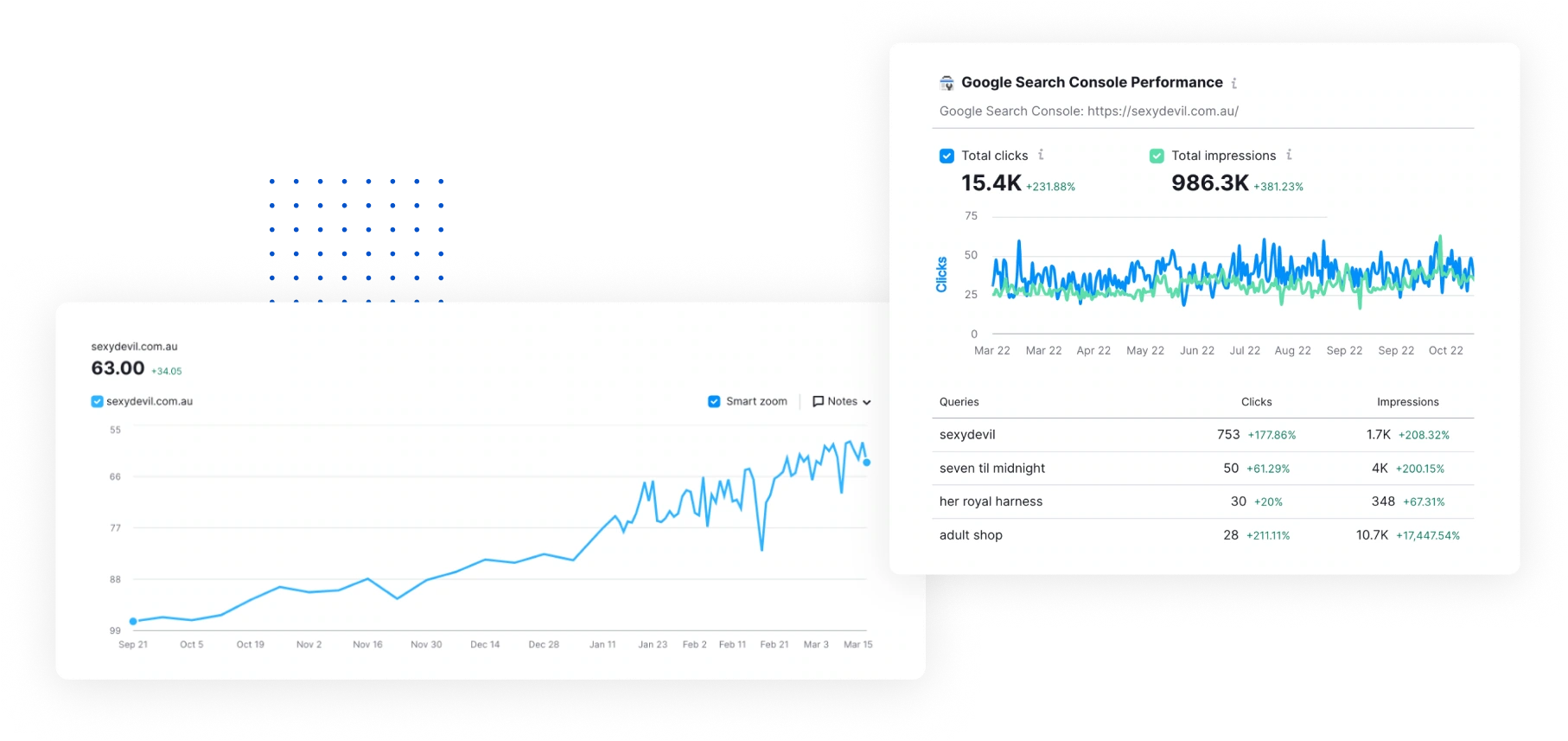
Over the six months from March to October 2022: website impressions rose 381%, organic click traffic rose 231%, average keyword ranking improved by 34 positions, and five fiercely contested high-traffic keywords reached the first page of Google. Site sales grew substantially over the same period (the specific figures are commercially sensitive and are not disclosed here).

The most significant element of these results is not a percentage but those five high-competition keywords. In an industry where established brands have long held the main traffic entry points, getting core terms onto the first page means an emerging brand has genuinely broken into the mainstream competitive positions — a change in kind rather than a quantitative accumulation.

Impressions growing 381% well ahead of clicks at 231% fits the stage characteristics of a concentrated breakthrough strategy: rebuilding product naming connected large numbers of pages to real search demand for the first time, producing a wave of newly ranking keywords in a short period. Those keywords generate impressions first, and need time to climb further before converting fully into clicks. In other words, a substantial volume of impressions was still waiting to be released.

That reading was subsequently confirmed — by 2024, clicks had grown 93% year on year and impressions 108%, with growth continuing after the core term rankings had consolidated.

For Sexy Devil, the significance of this project only becomes clear in its industry context: in a category where mainstream paid advertising channels are largely closed, organic search is the only scalable acquisition route. Opening that route amounted to building a sustainable online business foundation in a market where established brands held a clear head start and new entrants had virtually no shortcuts available.
Result Image

Related Projects

Check out other similar projects

GET A FREE QUOTE

Connect with us and let's make magic happen!

Melbourne

Scan the QR code to add our WeChat customer service for faster professional consultation.

WeBOOST WeChat customer service QR code, scan the code to add and learn about the local SEO solution in Melbourne, Australia