Drag

PawPawUp

PawPawUp is an online e-commerce company headquartered in Melbourne, Australia. The company's main business is to provide high-quality pet products and professional services to families with pets in Australia.

  • Category SEO
  • Industry Retail

Data from February 2023 to February 2024

The Problem

PawPawUp originally ran an offline pet supplies business and began moving online as e-commerce grew. Once the website was built, however, traffic fell far short of expectations and the online business failed to gain momentum.

The root cause is that offline and online acquisition work on entirely different logic. An offline business depends on two things: a physical location and regular customers. Neither asset transfers online — a website has no passing trade, and search ranking is its only location; nor do offline regulars automatically become online orders, since they are used to shopping in person and often do not even know the store has an online shopfront. The result was an e-commerce site that had absorbed real investment yet sat largely unvisited, with consumers simply unable to find its products through search.

The competitive environment made it harder still. Pet supplies e-commerce is a category heavily dominated by large platforms, whose rankings and spending on core category terms are not something a new entrant can meet head-on. Following the obvious path — put the products online, then compete on category keywords — gave PawPawUp essentially no chance.

What the client needed was a route to online acquisition that could bypass direct competition with the major platforms and deliver orders continuously at a sustainable cost — not simply a website capable of taking payments.

Our Solution

E-commerce SEO is judged on one thing: orders. We did not set the target at traffic or rankings, but organised the entire programme around which searches actually produce sales — with keyword selection, site structure, content and links each pointing at a specific stage of the purchase path.

Selecting Keywords by Conversion Potential

We analysed PawPawUp’s product categories, target audience, competitor keyword positioning and industry trends. The selection criterion was not maximum search volume but the combination of volume and conversion potential. A pet owner searching "cat litter" and one searching "large grain odour-control cat litter" are at completely different decision stages; the latter converts several times better at a fraction of the competitive intensity.

The selected keywords were then implemented in layers by page type: the homepage carries brand and broad category terms, category pages carry product-type and use-case terms, and product pages carry specific model and attribute terms. All keywords were used in natural language rather than stuffed — preserving readability while meeting current algorithmic standards.

Flat Site Architecture and URL Conventions

E-commerce sites carry large page counts, and excessive hierarchy depth leaves many product pages effectively uncrawled — and a page that is not indexed cannot rank at all. We restructured the category and sub-category hierarchy for clarity and applied a flat principle to every product page, ensuring each is reachable within three clicks of the homepage.

URL structure was standardised alongside, and internal linking redesigned so authority flows smoothly between category and product pages. The rebuild benefits both audiences at once: crawlers can traverse and correctly interpret the site, while users find the products they want faster, lifting conversion in the process.

Content Built Around the Purchase Decision

Product descriptions are the most overlooked and most leveraged element in e-commerce SEO. We rewrote them around the information the target audience actually cares about — ingredients, materials, how to use the product, and which pet sizes and ages it suits. That both covers a large volume of specific long-tail queries and directly answers the questions a buyer has before ordering.

On the blog side we published pet care knowledge and product buying guides to capture searches that have not yet reached the purchase stage. Pet owners are a notably high-retention audience — once they trust a source’s expertise they return repeatedly and buy again. Content here does more than generate traffic; it establishes a long-term relationship.

Technical Optimisation for Performance and Security

We improved site load speed, compressing image and video assets and introducing caching to lift responsiveness and reduce bounce rate. For an e-commerce site, load speed correlates directly with revenue — every additional second of waiting loses a proportion of users.

We also strengthened the site’s technical security, ensuring encrypted data transmission and eliminating potential vulnerabilities. For a store where users enter addresses and payment details, security is both a search ranking factor and a precondition for anyone being willing to order.

Vertical Link Building in the Pet Sector

We built a substantial base of high-quality links from within the pet industry, vetting every source for reputation and eliminating the risk of spam links.

We valued topical relevance and stability over raw numbers — links from authoritative pet-sector sites contribute far more to ranking within that subject area than general-purpose backlinks, and they simultaneously signal credibility to prospective customers.


The Result

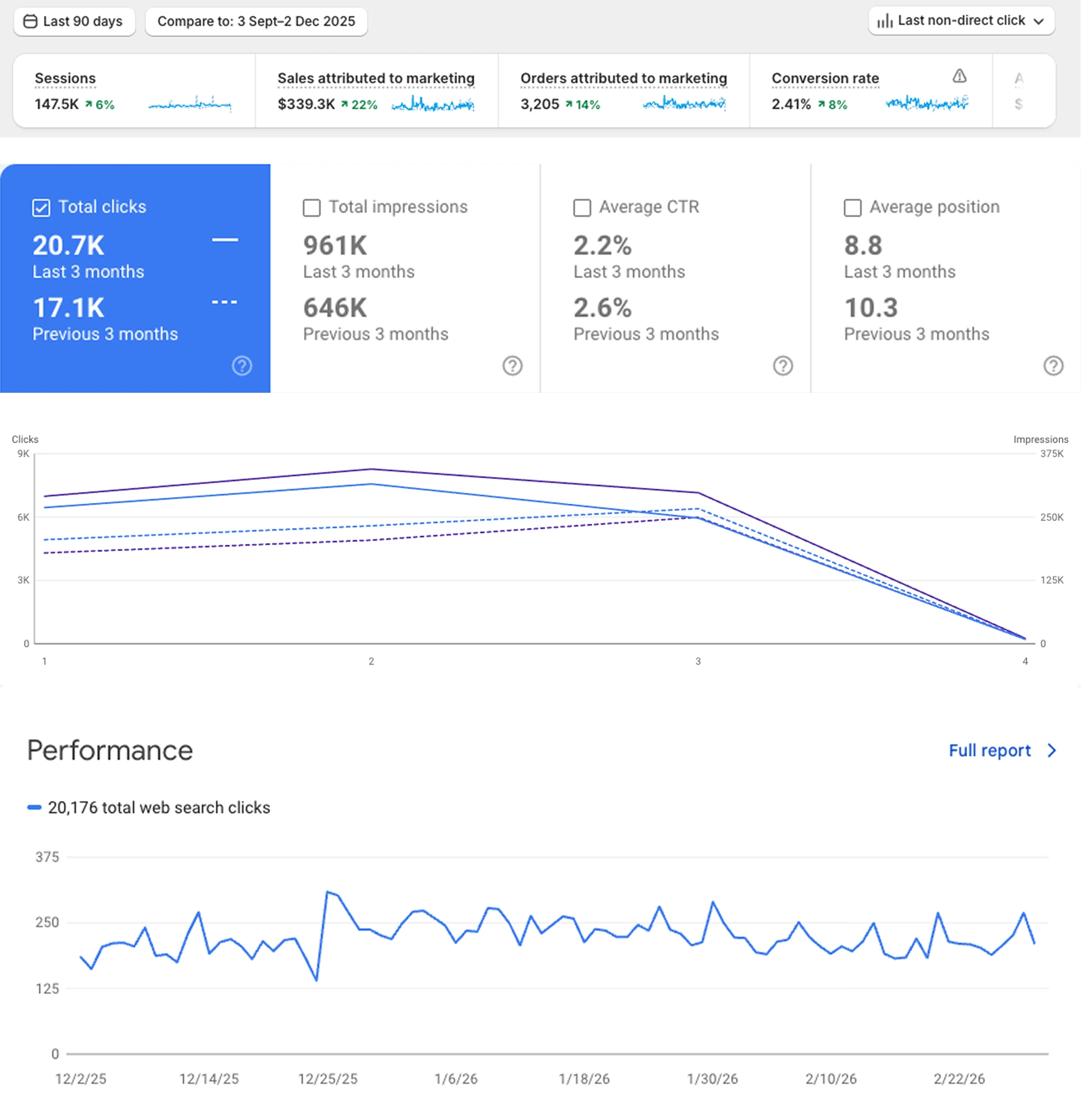
From February 2023 to February 2024: orders grew 257%, revenue grew 237%, average keyword ranking improved by 58 positions, and website traffic reached 298K.

What stands out about these results is that orders and revenue lead the list, not rankings and traffic. The value of SEO to an e-commerce business can only be measured in sales; however impressive the intermediate metrics, they mean nothing until they turn into orders.

The 58-position improvement in average keyword ranking is where all of it starts. That magnitude means large batches of keywords moved from depths users never scroll to into the range that actually generates clicks — for a new e-commerce site that was previously close to unsearchable, that is a zero-to-one shift.

Order growth of 257% slightly outpacing revenue growth of 237% indicates a modest easing in average order value. That is consistent with the customer mix produced by a long-tail keyword strategy: new customers arriving via specific product terms typically start with a single item. For pet supplies — a category with exceptionally high repeat-purchase rates — first-order value is not the point. Litter, food and treats are all consumables, and a satisfied new customer returns repeatedly over the following year or two.

Growth continued afterwards. By 2024 the site’s main keywords were ranking on the first page with some in the top five, while the keyword set continued to expand in line with market shifts; clicks grew 292% year on year, impressions rose 225%, sales volume grew 74% and revenue rose 83%.

For PawPawUp, what this project genuinely solved was the central difficulty of the transition: offline operating capability does not migrate online by itself, and in a pet supplies category dominated by major platforms, competing head-on for category terms was never realistic. Through precise long-tail coverage and systematic optimisation of the purchase path, PawPawUp bypassed direct competition and built an online acquisition channel that delivers orders consistently at a controllable cost.
Result Image

Related Projects

Check out other similar projects

GET A FREE QUOTE

Connect with us and let's make magic happen!

Melbourne

Scan the QR code to add our WeChat customer service for faster professional consultation.

WeBOOST WeChat customer service QR code, scan the code to add and learn about the local SEO solution in Melbourne, Australia