Fumens
Fumens Lawyers is a leading Chinese law firm in Melbourne, offering professional legal services in both Chinese and English to the local Chinese community. With offices located in Melbourne city center and the Chinese-populated area of Glen Waverley, the Fumens team brings extensive expertise in Australian law, practical experience across a variety of cases, and a proven track record of successful outcomes. They stay diligent in addressing Australia frequently updated legal regulations, ensuring client satisfaction with their dedicated and knowledgeable approach.
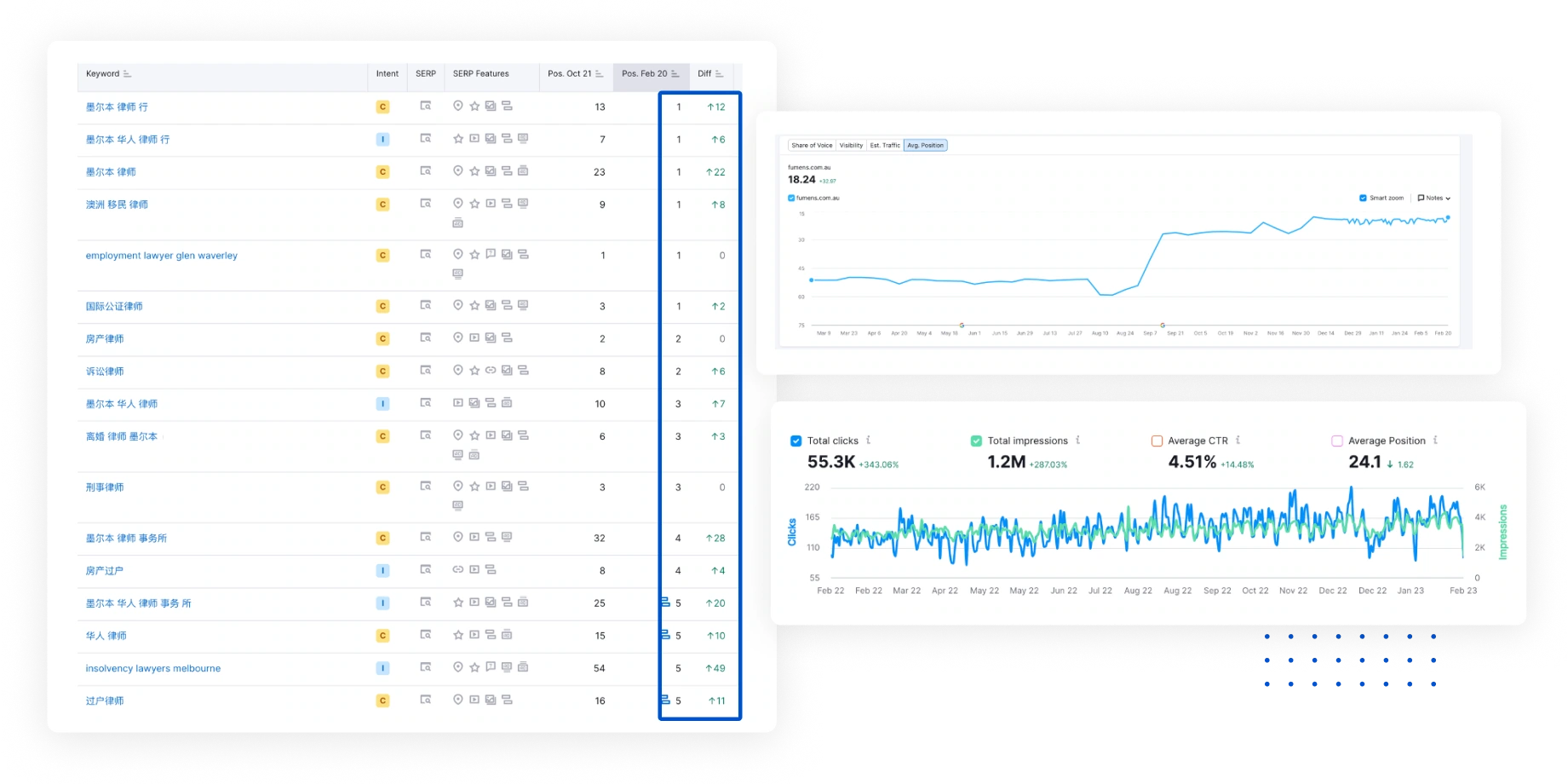
+ 33
Average Ranking
+ 287%
Website Impression
+ 343%
Website Traffic
+ 188
Google 1st Page Keywords
Data from February 2022 to February 2023
The Problem
Fumens Lawyers recognised the importance of online acquisition early and built a firm website, but after launch neither traffic nor brand visibility ever took off — people with a legal need could not find them when searching online, and online client acquisition was effectively zero.
That meant every client came from offline, predominantly through referrals from existing clients. The problem with referrals is not their quality but their ceiling: new client volume is limited by the size and social reach of the existing client base, and it self-reinforces — Chinese clients refer other Chinese clients. As a result Fumens’ client mix was extremely narrow, with almost no local or other-background clients, despite the firm having full bilingual Chinese and English capability and being perfectly able to serve that market.
The more immediate pressure is that legal services are a textbook low-frequency, high-value, time-critical need. The moment a client’s need arises it is usually urgent — they do not ask a friend and wait for a reply, they search. Being absent at that decision moment means forfeiting the overwhelming majority of the market.
The client’s brief was to build an acquisition channel that did not depend on personal networks, so that anyone with a legal need — Chinese-speaking or local — would find Fumens when they searched, breaking through the growth ceiling imposed by the referral model.

Our Solution
A law firm’s service scope is broad, but client searches are extremely specific — nobody searches "legal services"; they search whatever trouble they are in right now. Our approach followed that logic: split the site architecture by practice area, use content on specific problems to capture specific searches, then ensure the technical foundation lets that content be crawled and displayed in full.
Restructuring the Site by Practice Area
Fumens practises across family law, criminal law, employment law, migration and commercial law. The original site mixed all of it together, which both prevented users from finding what they needed and prevented search engines from determining what any given page was actually about.
We redefined the structure by practice area, giving each its own section within a clearly tiered service directory. The dual benefit is that users can follow their own problem straight to the relevant service page, while search engines can identify each page’s topical scope precisely — so a query like "Melbourne migration lawyer" lands on the right page instead of being diluted across a homepage competing with itself.
Keyword Research and Placement for the Melbourne Market
We conducted systematic keyword research around Fumens’ services and target audience, prioritising terms with meaningful search volume and moderate competition — the top-tier core terms in law carry prohibitive costs, and taking them head-on from the outset is not sensible.
Keywords were then placed methodically across the homepage and inner pages, ensuring content matched target terms closely. Long-tail terms were woven naturally into service pages, blog content and FAQs, covering the specific language users employ at different decision stages. Given Fumens’ bilingual capability, we built coverage in both Chinese and English, laying the groundwork for breaking out of a single-community client base.
Building a Legal Knowledge Content Base
Law falls into the YMYL categories Google reviews most strictly, and whether a site is judged a trustworthy source largely determines its ranking ceiling. We established a continuously producing legal knowledge base with the client: regularly identifying the legal topics of highest current interest and search volume, tracking competitors’ content activity, and building an editorial plan from both.
Formats span expert legal explainers, real case analyses and industry updates, continuously extending the site’s depth and breadth across each practice area. This content delivers genuine value to prospective clients and builds professional trust, while continuously demonstrating authority to search engines — the foundation on which a law firm site’s rankings rest.
Technical SEO and Site Fundamentals
We conducted a full technical review and remediation: page load speed, mobile device adaptation, HTML tag conventions, metadata and image optimisation, ensuring every page met search engine indexing standards.
Internal linking was the priority for reconstruction. We redesigned the relationships between pages so blog content could channel authority and traffic effectively into the corresponding service pages — someone who has just read an article about workplace injury compensation should flow naturally to the workplace injury service page, not stall at the end of the article.
Ongoing Monitoring and Algorithm Response
Google runs multiple algorithm updates each year, any of which can cause significant keyword ranking volatility — particularly in a high-competition field like law. We established real-time monitoring of keyword rankings, traffic and enquiry conversions, alongside tracking of competitor activity.
When a core term slipped, we could identify the cause and correct it within a short window, keeping terms such as "Melbourne lawyer", "Melbourne Chinese lawyer", "Melbourne law firm" and "Australian migration lawyer" consistently in strong positions. SEO value accrues over time, and defending existing ground matters as much as taking new ground.
The Result
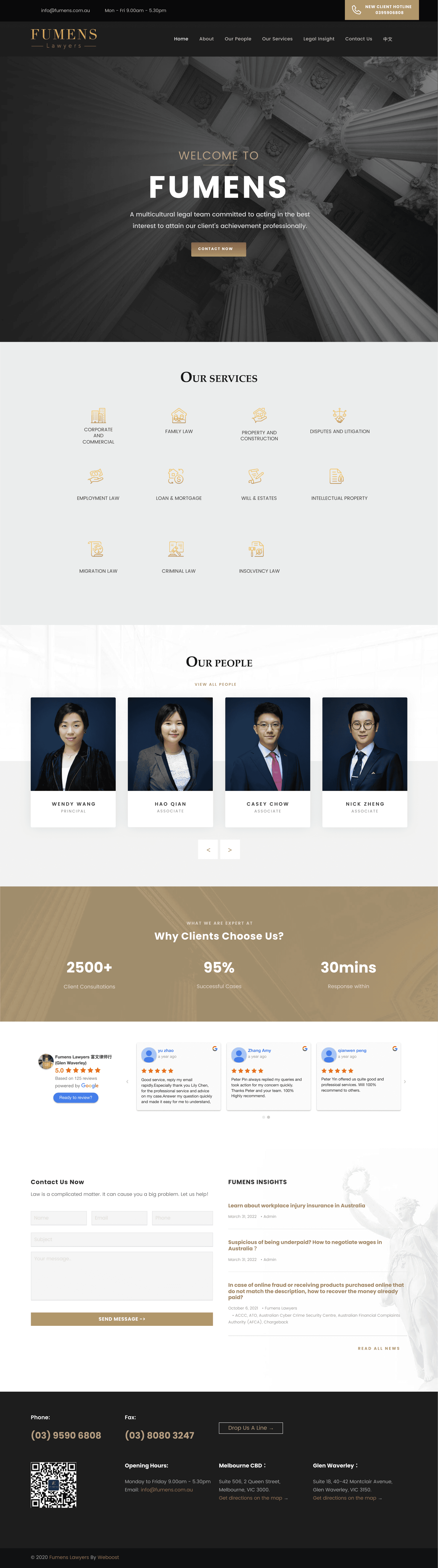
From February 2022 to February 2023: website traffic rose 343%, website impressions rose 287%, average keyword ranking improved by 33 positions, 188 keywords reached Google’s first page, and the site’s bounce rate fell 36%.
The most notable relationship here is that traffic growth (343%) outpaced impression growth (287%). In SEO projects this is usually the other way round — expanding coverage first produces a wave of impressions, while click-through rate is diluted because the new terms still rank poorly. Fumens showed the opposite pattern, which means growth was not achieved through volume but through existing keywords genuinely moving up the page. The 33-position improvement in average ranking is the direct expression of that: each position gained in search results produces a non-linear lift in click-through rate.
The 36% reduction in bounce rate validates traffic quality from another angle. Visitors were not leaving after a single glance, which means their search intent genuinely matched what the landing page offered — the result of restructuring the site by practice area so specific queries land on the right service page.
Law is among the fields most sensitive to Google algorithm updates, each of which can trigger severe ranking volatility. Through continuous monitoring we identified and corrected issues quickly during the project, and core terms including "Melbourne lawyer", "Melbourne Chinese lawyer", "Melbourne law firm" and "Australian migration lawyer" held their positions without slipping through algorithm changes.
The gains continued to compound in subsequent years. By 2024 the majority of the site’s keywords were holding on the first page with core terms in positions one and two; clicks grew 195% year on year, impressions rose 136%, and enquiry volume rose 118%. That final figure is the real destination of this project — Fumens finally established an acquisition channel independent of client referrals, breaking through a growth ceiling that had previously been set by the size of its personal network.
Related Projects
Check out other similar projects





Get a Free Quote
Let's talk about your goals
Melbourne
Scan the QR code to add our WeChat customer service for faster professional consultation.