Kylin Australia
Kylin Australia is an Australian sauna and recovery equipment brand specialising in infrared saunas, traditional Finnish steam saunas, red light therapy devices and ice baths. Products range from one to four person capacity for both indoor and outdoor installation, backed by Australia-wide delivery, professional installation and full warranty support. The brand operates showrooms in Melbourne, Sydney, Brisbane, the Gold Coast, the Sunshine Coast and Perth, serving athletes, fitness enthusiasts and consumers focused on recovery and long-term health.

+ 76.9%
ROAS
+ 11.2%
CTR
- 22.7%
CPC
+ 107.5%
Conv. Rate
Data from the 2024 Christmas season
Client Background
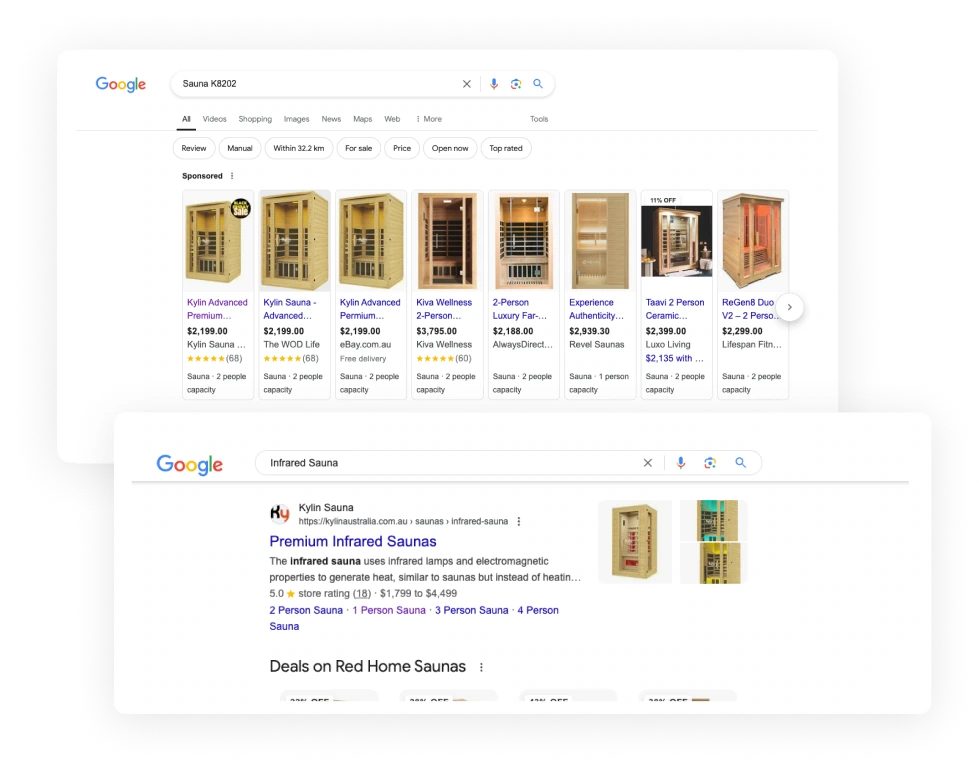
Kylin Australia is an Australian sauna and recovery equipment brand. Its range spans infrared saunas (including low-EMF and full-spectrum models), traditional Finnish steam saunas, red light therapy panels and mats, ice baths, and peripherals including heaters, floor heating, accessories and replacement parts — in sizes from one to four people, for both indoor and outdoor installation.
Unlike a purely online retailer, the client runs a combined model: acquire online, experience offline. On one side it offers Australia-wide delivery, professional on-site installation, and comprehensive warranty and after-sales support. On the other it maintains physical showrooms across six cities — Melbourne, Sydney, Brisbane, the Gold Coast, the Sunshine Coast and Perth — where customers can try the product before buying. The brand has partnerships with fitness chains including Genesis Health Fitness and Fernwood Fitness, and its core audience is athletes, fitness enthusiasts, and consumers who take physical recovery and long-term health seriously.
The Problem
Sauna equipment is a textbook high-value, long-consideration purchase — individual orders run from several thousand to well over ten thousand dollars, and buyers typically compare options for weeks or months before committing. In a business like this, the danger is not a lack of traffic; it is money spent on clicks that will never convert.
The client faced three specific problems. First, the search intent behind core terms like “sauna” is deeply mixed — a large share of those searches come from people looking for a service, a sauna room or spa, rather than looking to buy a unit. Those clicks generate cost and nothing else. Second, saunas and ice baths are still an emerging category in Australia, and many prospective buyers sit at the "heard of it but do not really understand it" stage; their searches scatter across category terms, benefit terms, symptom terms and competitor names, none of which core keywords alone can reach. Third, the six showrooms were the client’s single biggest conversion asset, but advertising ran uniformly across the country, with no way to route regional traffic to the nearest showroom experience.
The client wanted professional Google Ads management that would filter out wasted clicks, improve the quality of enquiries and showroom bookings, hold cost per conversion at a sustainable level, and cover the national market while still operating city by city.
Our Solution
Layering Search Intent and Building a Negative Keyword System
The first thing we did was not add keywords, but remove them. Working through the search terms report line by line, we split the traffic into three groups: clear purchase intent (“infrared sauna for sale”, “home sauna price”), research-stage informational intent (“infrared sauna benefits”, “sauna vs steam room”), and entirely irrelevant service intent (“sauna near me”, “spa massage”).
For the third group we built and continuously maintained a negative keyword list covering service, venue, recruitment and cheap second-hand queries, cutting off wasted clicks at the source. The first group received concentrated budget and exact match. The second was given its own campaign at lower bids, paired with content-led landing pages that hold those users in the remarketing pool until their decision matures. This single step moved budget away from traffic that merely looked busy and back onto traffic that actually converts.
Restructuring the Account by Product Line and City
What had been a single blended account was rebuilt into a two-dimensional Product Line × Region structure: infrared saunas, traditional steam saunas, red light therapy and ice baths each became separate campaigns, with the six showroom cities each given their own geographic targeting and budget.
This split delivered two immediate benefits. First, the four product lines differ sharply in order value, competitive intensity and conversion rate — only independent bidding lets each find its own optimum. Second, cities with a showroom could emphasise “visit your nearest showroom” directly in ad copy and extensions, while regions without one led with Australia-wide delivery and professional installation — two messages that no longer interfered with each other. Budget could also be reallocated dynamically according to each city’s actual return, rather than being spread evenly across the country.
Designing a Conversion Path for a Long Decision Cycle
Almost nobody sees an ad for a high-value product and buys immediately. If the only conversion goal is the final sale, the algorithm receives too few data points and its learning period drags on indefinitely. We therefore built a layered conversion structure: showroom bookings, enquiry form submissions, brochure downloads and quote requests were each defined as conversion actions of differing value, feeding the smart bidding system a steady stream of high-frequency micro-conversions so it could identify high-intent audiences far more quickly.
On the landing pages, those entry points were made prominent and low-friction. Rather than asking a visitor to commit to a five-figure decision in one sitting, we asked for one very cheap interaction first, and built the relationship from there.
Aligning Ads with Landing Pages
We built a dedicated landing page for each product line, ensuring strict consistency between what was searched, what ad appeared, and what page it led to — rather than funnelling all traffic into the homepage. Page content front-loaded the factors customers actually weigh: warranty terms, professional installation, showroom addresses and opening hours, product specifications and size comparisons, and the fitness industry partnerships that provide third-party credibility.
In the copy itself, research-stage audiences were met with educational content and expertise, while purchase-stage audiences were met with price, availability, delivery and installation. This also lifted quality scores, pushing click costs down further.
Matching Remarketing to the Purchase Cycle
For a decision cycle running from weeks to months, we built remarketing audiences segmented by depth of behaviour: people who had viewed product pages, entered the quote flow, or downloaded a brochure without purchasing each received a different ad sequence and bid. Early in the cycle, product comparisons, use cases and real customer stories maintained brand presence; later, as customers approached a decision, limited-time offers and showroom booking invitations were served. The long hesitation period became something to work with, rather than a place where traffic quietly disappeared.
The Result
After the account restructure and ongoing optimisation, Kylin Australia’s Google Ads performance improved structurally through the 2024 Christmas season: ROAS rose 76.9%, conversion rate rose 107.5%, click-through rate rose 11.2%, and cost per click fell 22.7%.
These four numbers only make sense read together. Click-through rate rising while click cost falls is the classic signature of improved ad relevance — intent layering and the negative keyword system ensured ads appeared only on genuinely relevant queries, Google rewarded that with a higher quality score, and the same positions became cheaper to hold. The doubling of conversion rate shows the people arriving were simply better matched: at 107.5%, its growth vastly outpaced the 11.2% lift in click-through rate, meaning the gain came from better-qualified visitors, not merely from more people clicking.
Costs down and conversions up on both sides compounded into the 76.9% ROAS improvement — every dollar spent returning close to eighty percent more revenue than before. What makes this particularly notable is that the data comes from the Christmas season, the most expensive and most fiercely contested period of the year. Driving click costs down during peak season demonstrates the improvement came from account structure and traffic quality themselves, rather than from sidestepping competition.
Commercially, advertising stopped being a mechanism for pushing traffic at a website and instead connected properly to the client’s full chain of online acquisition, offline experience and professional installation: cities with showrooms routed traffic to the nearest in-person experience, while other regions led with delivery and installation. Layered conversions and remarketing also removed the long decision cycle as an obstacle — research-stage prospects were captured into the remarketing pool and converted progressively over time, giving the client a repeatable acquisition model for continuing to expand its share of the Australian sauna and recovery market.
Related Projects
Check out other similar projects


Get a Free Quote
Let's talk about your goals
Melbourne
Scan the QR code to add our WeChat customer service for faster professional consultation.